
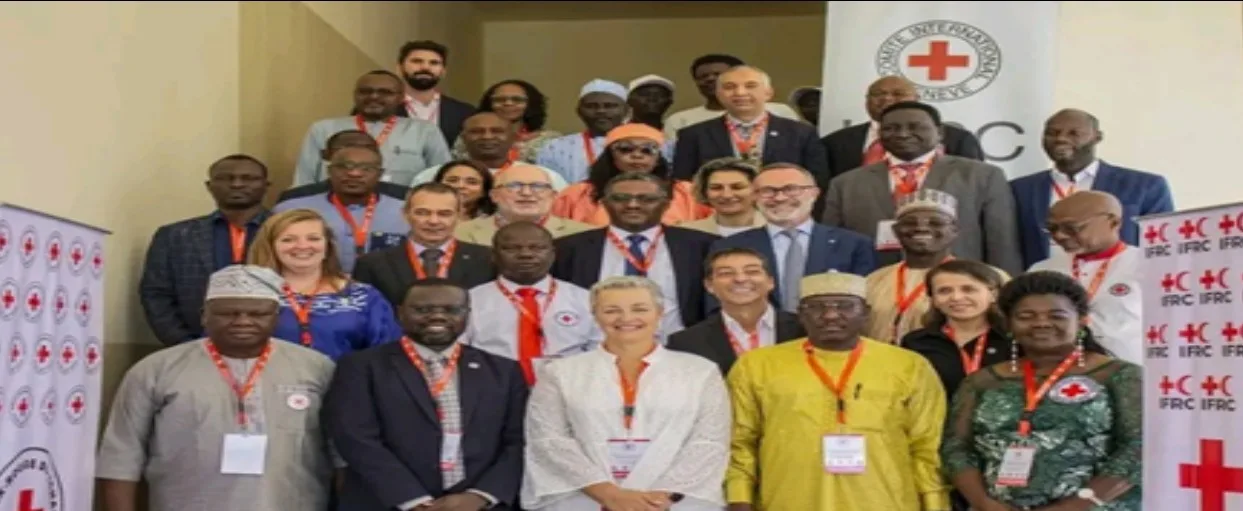
The Cameroon Red Cross is taking part, on October 20 and 21, 2026 in N’Djamena, Chad, in the regional meeting of the International Red Cross and Red Crescent Movement dedicated to strengthening humanitarian cooperation in response to the crises affecting the Lake Chad Basin.
In the face of protracted crises, humanitarian solidarity can no longer stop at national borders. In the Lake Chad Basin, where conflicts, population displacement, food insecurity, and the effects of climate change weaken communities, coordination among humanitarian actors represents a major issue. It is from this perspective that representatives of the International Red Cross and Red Crescent Movement gathered in N’Djamena, Chad. The National President of the Cameroon Red Cross, Cécile AKAME MFOUMOU, is participating in these discussions alongside representatives of the National Societies of Cameroon, Niger, Nigeria, and Chad, the International Committee of the Red Cross (ICRC), the International Federation of Red Cross and Red Crescent Societies (IFRC), and partner National Societies. This mobilization aims to consolidate collaboration mechanisms among organizations engaged in assisting populations affected by crises.
Shared Priorities in the Face of Multiple Needs
At the heart of the discussions is the evolution of humanitarian needs in the region. The consequences of conflict and insecurity, population movements, and difficulties in accessing essential resources require constant adaptation of interventions. Displaced communities, host families, and populations exposed to climate hazards are among those whose needs require
sustained attention. In this context, participants are examining the Movement’s priorities to promote better articulation of actions in the field. The goal is to strengthen cross-border cooperation among National Societies, improve the coordination of operational strategies, and promote a coherent use of available capacities. This approach is particularly important in a region where the consequences of a crisis can rapidly ripple from one country to another. Enhanced consultation makes it possible to better anticipate needs, share experiences, and facilitate the continuity of assistance when populations move across borders.
Complementarity of Actors and Effectiveness of Interventions
The meeting also accords significant place to humanitarian diplomacy and the complementarity of interventions by the ICRC, the IFRC, and National Societies. Despite their respective mandates and scopes of intervention, these components of the Movement pursue a common goal: to prevent and alleviate human suffering while providing tailored assistance to the most vulnerable individuals. The ICRC operates notably in situations of armed conflict and violence, whereas the IFRC supports National Societies in capacity building and response to disasters and other crises. National Societies, for their part, rely on their local presence and networks of volunteers to act closest to communities. Consultation among these actors must thus foster a better distribution of effort, limit overlapping interventions, and strengthen the impact of aid. It also offers a framework to bring humanitarian concerns to decision-makers and promote responses that are better adapted to population realities. For the Cameroon Red Cross, this meeting constitutes an opportunity to participate in regional reflection on the solidarity and cooperation mechanisms necessary in the face of cross-border crises. The discussions in N’Djamena thus highlight a fundamental imperative, which is to make coordination a concrete lever to bring assistance closer to the people who need it most.
At the conclusion of these two days, the challenge will be to translate shared priorities into coordinated actions capable of responding more effectively to humanitarian needs across the Lake Chad Basin.
Marie Chantale FAIDA