
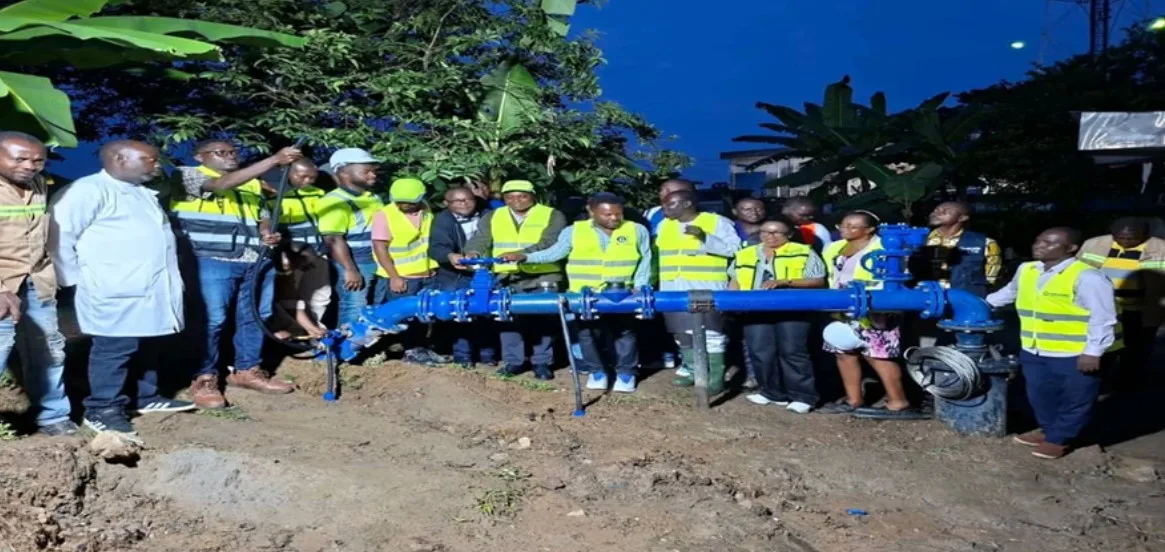
Equipped with a deep-casing well and an integrated treatment system, the new industrial borehole adds an extra capacity of 3,000 m³/day.
The public drinking water service in Cameroon’s economic capital has achieved a major qualitative milestone. On Thursday, October 22, 2026, the General Manager of Cameroon Water Utilities Corporation (CAMWATER), Dr. Blaise MOUSSA, presided over the official commissioning ceremony of the Ndogbong industrial borehole in the city of Douala. This highly technical infrastructure represents the first phase of a comprehensive emergency plan designed to sustainably resolve the water deficit in densely populated urban and peri-urban areas.
Historically, the drinking water supply to the Ndogbong sector and its surroundings relied almost exclusively on water piped from the major treatment plants at Japoma and Bassa. This setup left the local supply particularly vulnerable to pressure fluctuations, technical incidents, or maintenance operations along the main transmission lines. The commissioning of the Ndogbong facility marks a major operational and technical shift, establishing the site as a fully autonomous production unit. Built to rigorous engineering standards, the infrastructure features a deep-casing well with a 250-millimeter diameter. It is equipped with an automatic electrical control panel to regulate flows and an inline chlorination system directly integrated at the source. This operational independence secures production, provides a strategic reserve for the economic metropolis, and insulates the local distribution network from upstream disruptions.
The technical and hydraulic specifications of this infrastructure highlight the scale of the project. Designed to deliver a nominal flow rate of 140 cubic meters per hour, the system offers an expandable capacity of up to 200 cubic meters per hour, depending on the yield of the targeted aquifer. Operationally, the immediate output from the Ndogbong site provides an additional volume of approximately 3,000 cubic meters per day—injecting 3 million liters of drinking water daily into the existing 3,000-cubic-meter storage tank. This initial contribution is part of a broader plan involving four high-yield urban boreholes designed to supply a cumulative flow rate of 800 cubic meters per hour, ultimately adding over 17,600 cubic meters per day (17.6 million liters daily) to Douala’s water supply network.
Injecting this new resource into the distribution network is producing measurable benefits for connected households. The most significant improvement lies in pumping times and overall water availability. Whereas residents in the area previously had access to running water for only 4 to 6 hours a day, daily supply duration has now increased to 10–11 hours, effectively doubling tap availability. This enhanced network fluidity directly benefits several sub-neighborhoods and
peripheral zones across the economic capital, including Ndogbong and its immediate surroundings, the residential and commercial district of Makèpè, Cité des Palmiers, Logbessou, and areas adjacent to the PK corridors. The technical impact is particularly striking at the Cité des Palmiers booster station, where pumping time has surged from 1 hour 30 minutes to 6 hours per day, enabling better pressure distribution across secondary networks.
The commissioning of the Ndogbong industrial borehole represents only the initial milestone in a broader hydraulic offensive led by CAMWATER’s top management. To date, the emergency program has reached an overall completion rate of 50 percent, with full completion expected within two months. Over the coming days, the three remaining industrial boreholes planned under this scheme—located in Cité des Palmiers, Koumassi, and Logbessou—will be progressively brought online. They will feature the same proven technical layout, encompassing hydraulic engineering, electrical controls, automated water treatment, and civil works. Through this expansion of localized infrastructure, CAMWATER reaffirms its commitment to modernizing production assets and ensuring equitable, continuous access to drinking water for all residents of Douala.