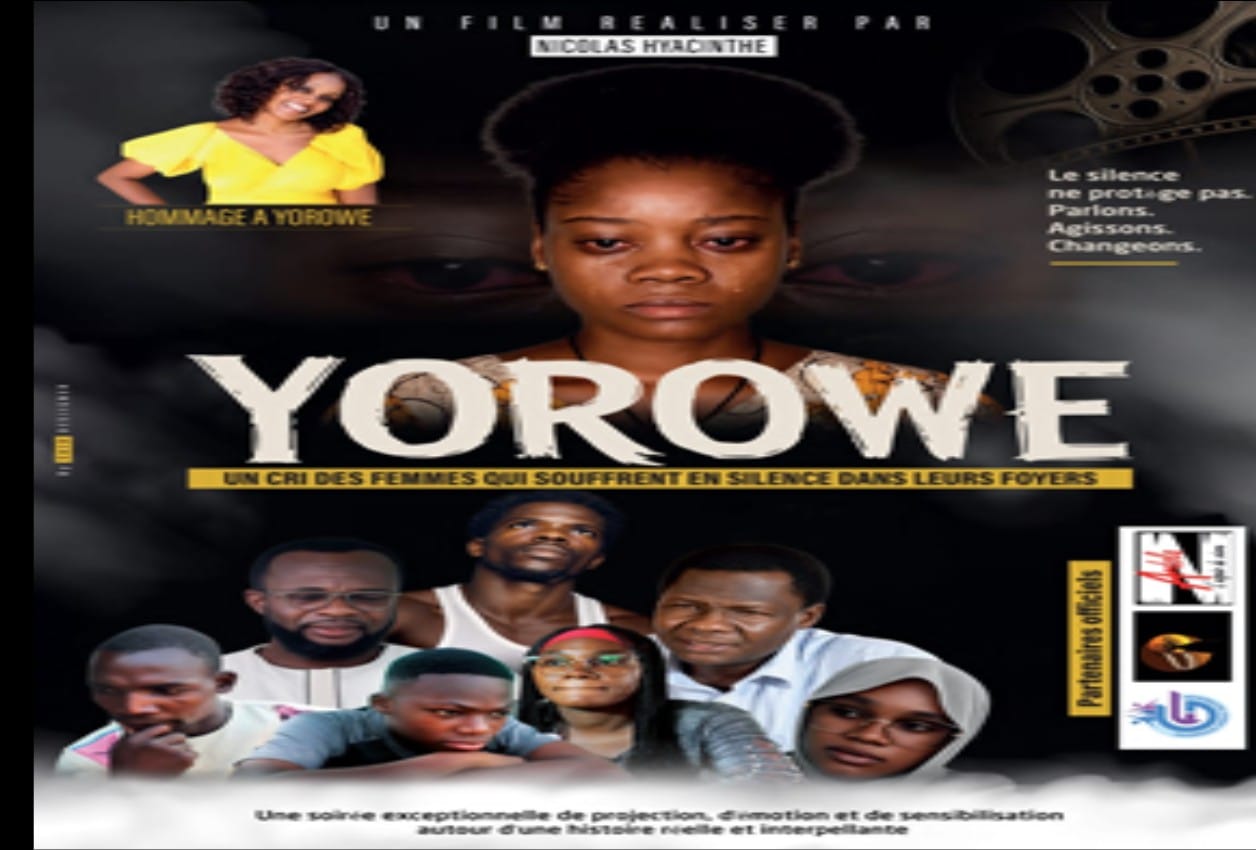
Officially screened on 27 June 2026 in Garoua, the short film Yorowé, inspired by true events, is a work of awareness-raising on domestic violence. The film challenges consciences on a phenomenon that continues to shatter lives in the north and across Cameroon.
The official screening of the film Yorowé took place in the city of Garoua. This committed cinematic work places the fight against domestic violence at the heart of the social debate. Lasting 35 minutes, this short film, inspired by true events, stirred deep emotion among the many spectators who came to discover this production with strong socio-cultural impact. Through the tragic destiny of a young married woman, the film plunges the audience into the often-silent reality of violence against women within the home. Abused, humiliated, victim of repeated physical violence and numerous bodily assaults, the heroine gradually sees her health deteriorate before succumbing in hospital. A dramatic ending that reminds us that behind the statistics lie lives, broken families and suffering too often swept under the carpet.
The narrative traces with sobriety and realism the dark journey of the victim, from the first manifestations of violence to the fatal outcome. Far from being a simple fiction, Yorowé seeks to be a mirror of a reality experienced by many women. The film highlights the weight of silence, fear, economic dependence and social pressures that often prevent victims from denouncing their abusers or seeking help.
In a context where domestic violence remains a major concern in Cameroon, and particularly in the northern regions, the message carried by this work finds particular resonance. Many women still suffer physical, psychological or economic abuse in the intimacy of the home. Many choose to remain silent, sometimes until the irreparable occurs.
The screening of Yorowé thus appears as a true call to collective conscience. The film invites families, communities, religious leaders, administrative authorities and society as a whole to engage more strongly in the protection of women and the promotion of family relations based on mutual respect and human dignity. Promoter of the cinematic project, Rev. Sanda Saidou took care to explain to the public the scope of this awareness-raising initiative. He wishes to encourage victims to speak out, to seek help and no longer consider violence as an inevitability.
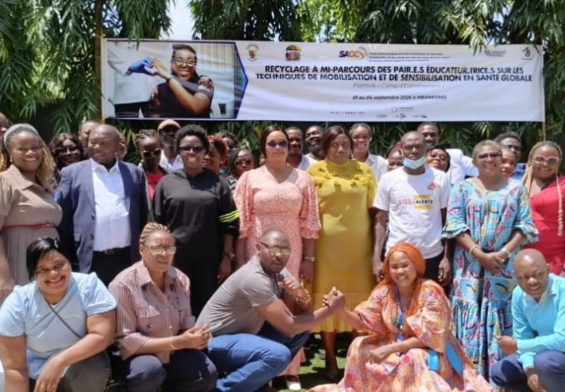
Present at this ceremony through his representative, the Governor of the North region also
welcomed the initiative. The Secretary General of the Governor’s services, Joseph Densou, congratulated the promoter for the quality of the production as well as for the relevance of the message conveyed. In his speech, he recalled the commitment of public authorities in favour of the protection of human dignity and the rights of vulnerable persons. He particularly insisted on the need to promote harmonious relations within couples and families.
Emotion was palpable at the end of the screening. Several spectators shared their impressions. « The message was moving, the film taught us, » confided Tchanzin Martin, visibly marked by the scenes projected on the screen. Charlotte, another participant, for her part launched an appeal to men so that they become more protectors and respectful partners of their wives. « Violence does not resolve conflicts, » she recalled.
Interview
« Through Yorowé’s cry from the heart, we are launching an appeal for restraint and respect, based on human rights that guarantee health, physical and moral integrity. »

Why did you choose the medium of film to raise awareness against domestic violence?
Film was chosen as a means of awareness-raising because it allows us to touch emotions, to break the silence around a taboo subject and to provoke a collective awareness that is stronger than simple theoretical speeches. Images and cinematic narratives make visible realities that are often hidden. Films create an emotional immersion that helps the audience to feel the suffering of the victims. Domestic violence, often concealed and surrounded by shame, is exposed directly through cinema, which helps to free speech and reduce social silence. Thus, the film becomes a powerful vector of awareness, capable of transcending social and cultural
boundaries.
Where does the name Yorowé, the film’s title, come from?
In the Gbaya language, the term Yorowé means « peace » or « appeasement. » It is a word that refers to the idea of reconciliation and social harmony, often used in contexts of conflict resolution or community cohesion. This was the name of my little sister who died as a result of domestic violence. By choosing Yorowé as the film’s title, we wish not only to pay tribute to the deceased through this film that tells her story, but also to express our desire to see homes and society restored, by denouncing domestic violence and calling for harmony and human dignity.
What message are you seeking to convey through the film?
Before getting to the message, we want to recall some figures related to gender-based violence in Cameroon. During her press conference of 23 April 2026, Mrs Marie Thérèse Abena Ondoa, Minister for the Promotion of Women and the Family, revealed alarming figures. Around thirty women killed in the first quarter of 2026, several cases of infanticide and a resurgence of domestic and family violence. Nearly 39% of women victims of physical violence. Tragedies like those in Evodoula, a woman killed with a machete by her husband; in Douala, a wife fatally assaulted by her partner; in Kousseri, a woman stabbed to death by her husband; in Kribi, a nursing student murdered, her companion suspected.
On 25 February 2024, we had a long conversation with Yorowé, our little sister, about the violence she was suffering in her home. At the end she said to me, « You are a pastor, preach and tell men not to raise their hands against their wives anymore. » Based on this reality, the film Yorowé comes to awaken consciences and remind us that violence never solves problems. Through Yorowé’s cry from the heart, we are launching an appeal for restraint and respect, based on human rights that guarantee health, physical and moral integrity. To reinforce this message, we want to recall the Universal Declaration of Human Rights (UN, 1948), Article 3: « Everyone has the right to life, liberty and security of person. » Article 5: « No one shall be subjected to torture or to cruel, inhuman or degrading treatment or punishment. » These articles remind us that domestic violence constitutes a serious violation of fundamental rights, because it threatens the life, security and dignity of victims.
In summary, the film Yorowé carries a message articulated around two fundamental dimensions. First, it is a matter of firmly denouncing domestic violence, recalling that silence protects the aggressor and crushes the victim, thus depriving thousands of women of their right to life, liberty and security of person, as guaranteed by Article 3 of the Universal Declaration of Human Rights. Second, the film proclaims the hope of a restoration of peace, family harmony and respect for human dignity, relying on Article 5 which prohibits all forms of torture or cruel, inhuman or degrading treatment. Thus, Yorowé is not limited to telling a tragic story; it becomes a universal plea for the protection of human rights, the liberation of speech and the construction of homes founded on love, respect and justice.