

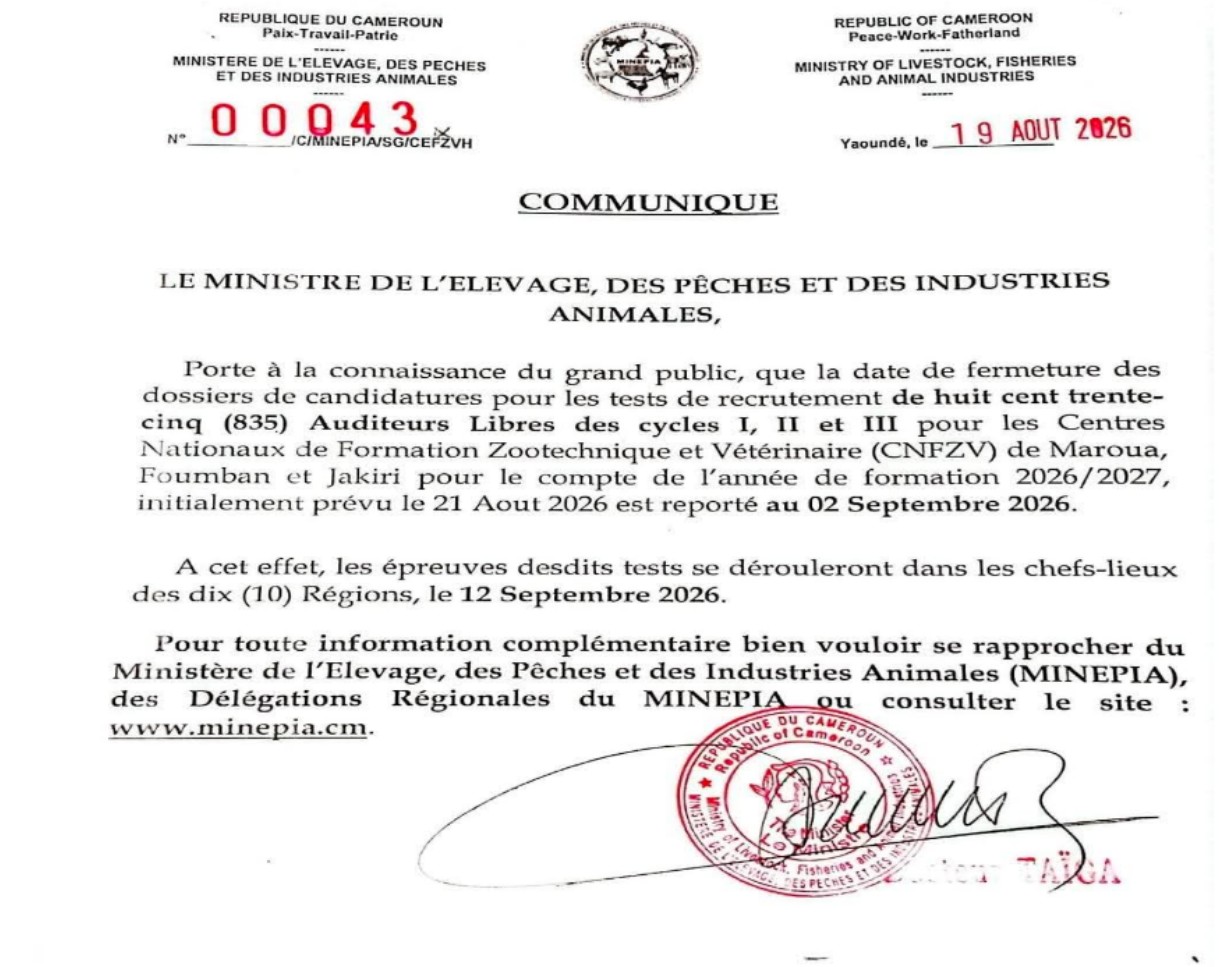
Initially set for August 21, the closing date for applications for zootechnical and veterinary training cycles has been postponed to September 2, 2026 by MINEPIA.
This news will bring great relief to thousands of young Cameroonians. The Ministry of Livestock, Fisheries and Animal Industries (MINEPIA) has just announced a postponement of the application deadline for the recruitment tests for auditors in cycles I, II, and III at the National Zootechnical and Veterinary Training Centers (CNFZV) in Maroua, Foumban, and Jakiri. Originally scheduled for August 21, 2026, the deadline has now been extended to September 2, 2026. This decision demonstrates the Ministry’s commitment to giving potential candidates, often located throughout the country, every opportunity to prepare and submit their applications on time.
This measure, which might seem insignificant, is in fact of paramount importance. It is part of a logic of fairness and transparency, allowing young people from all ten regions of Cameroon, including the most remote, to apply under favorable conditions. The entrance exams will take place on September 12, 2026, in the capital cities of the ten regions, thus facilitating access for candidates and reducing the logistical constraints that could have disadvantaged some of them.
Eight hundred and thirty-five places to train the professionals of tomorrow
A total of 835 auditors will be recruited for the 2026/2027 academic year, distributed across the three study cycles. These programs, offered at national zootechnical and veterinary training centers, are essential for the development of the livestock, fisheries, and animal processing sectors in Cameroon. They aim to train technicians and engineers capable of meeting the challenges of food sovereignty, food safety, and the modernization of agricultural and pastoral practices.
The Maroua center, located in the Far North region, has historically focused on the challenges of the Sahelian zone, specializing in extensive livestock farming and pastoral resource management. The Foumban center, in the West, is renowned for its programs in animal health and dairy production. Finally, the Jakiri center, in the Northwest, is distinguished by its training in fish farming and aquatic ecosystem management. These three institutions form the foundation of technical and vocational training in the livestock and fisheries sectors, thereby contributing to job creation and poverty reduction in rural areas.
Train to feed Cameroon
Beyond the technical and administrative aspects, this recruitment is a crucial step in the implementation of public policies supporting livestock and fisheries. It aligns perfectly with the objectives of the SND30 (National Development Strategy 2020), which aims to strengthen the country’s food sovereignty through the development of the livestock and fisheries sectors. The independent trainees recruited in 2026 will benefit from high-quality training, combining theory and practice, and will be called upon to become key players in the sector’s transformation.
Postponing the application deadlines is therefore much more than a simple administrative measure. It is a gesture of consideration for Cameroonian youth, an invitation to seize the opportunities offered by the State, and an affirmation of the central role of education in the country’s sustainable development. As the deadline of September 2, 2026, approaches, potential candidates have only one watchword: prepare, apply, and take up the challenge of an excellent education to build the Cameroon of tomorrow.


