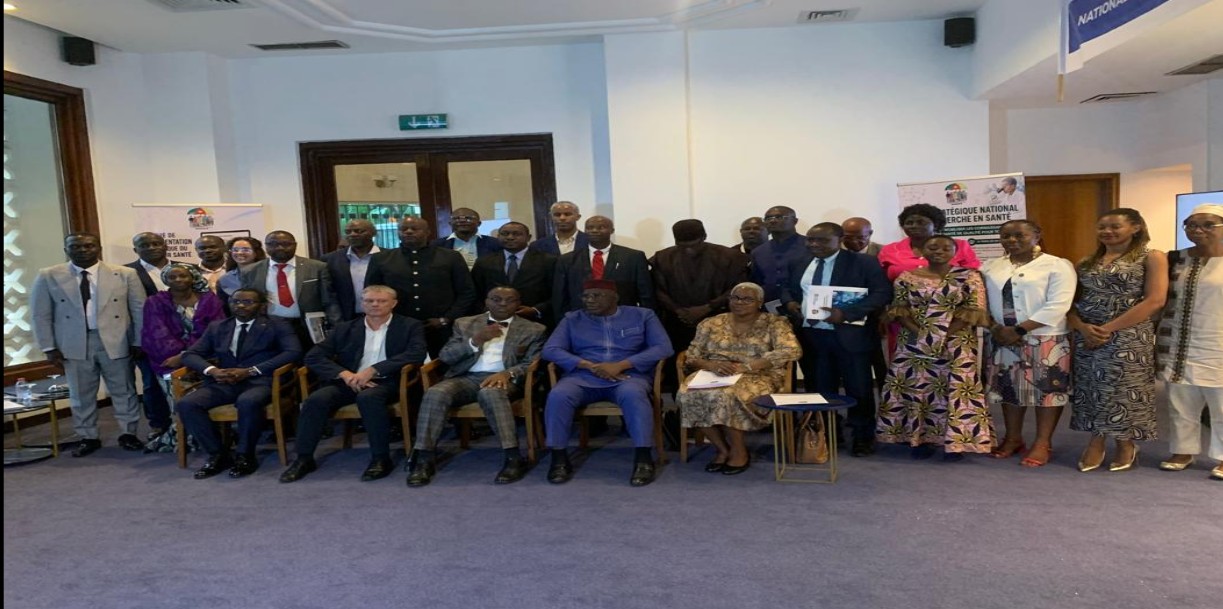
On September 1, 2026, the Ministry of Public Health officially launched in Yaoundé the National Strategic Plan for Health Research (PSNRS 2026-2030) and the Digital Documentation Center for the Health Sector (CDNSS).
“Research must not remain confined to laboratories or libraries,” emphasized Professor Louis Richard Njock, Secretary General of the Ministry of Public Health, representing Dr. Manaouda Malachie, at the official launch of the National Strategic Plan for Health Research (PSNRS 2026-2030) and the Digital Documentation Center for the Health Sector (CDNSS) in Yaoundé. “Its true value lies in its ability to reach even the most remote health district, where community health workers confront the raw reality of disease.”
This dual historical recognition addresses a persistent divide: the one separating the knowledge produced at the top from the needs expressed at the grassroots level. « Why do results differ across regions? Why is access to care unequal? » asked Professor Njock, calling for the PSNRS to become « a space for observation, innovation, and improvement of public policies. »
Samuel Kamwa, coordinator of the Data for Health program (Vital Strategies/Bloomberg Philanthropies), detailed the plan’s development: “We worked for a year with the Division of Operational Research in Health (DROS). Interviews, focus groups, field visits, and interviews with key individuals all converged to provide a unique situational analysis.” He emphasized the plan’s operational focus: “The plan addresses the real needs of stakeholders. We defined ten research priorities around major health issues and emerging diseases, as well as population-based priorities—pregnant women, children—and territorial priorities.”
Gildas Nguemkam, advisor to the Regional Health Directorate (DROS), added: “Beyond the specific themes, we targeted isolated areas and regions with challenging geography. These are the areas with the least access to healthcare.” He continued: “Every healthcare system develops through research. Without knowledge, there can be no informed decisions.” When asked about the budget, he replied: “The estimate was prepared in consultation with all stakeholders. We are confident that it will cover the needs for the next five years.”
The two main instruments – PSNRS and CDNSS – act in tandem. The former plans and prioritizes research over five years; the latter centralizes, preserves, and makes accessible all local scientific output. “The ambition,” emphasizes Samuel Kamwa, “is for the best information to reach the right person, everywhere in the country.” The CDNSS allows us “to pool resources, strengthen national capacities,and align our work with public health priorities,” adds Gildas Nguemkam, echoing Professor Njock’s introductory remarks.
This synergy is based on strong partnerships: Vital Strategies, Bloomberg Philanthropies, MINRESI, MINESUP, UN agencies, research institutes, and civil society. “It’s a collective and inclusive vision,” concluded Professor Njock. “Under the leadership of the President of the Republic, the government is making access to quality healthcare a priority. These tools will foster a less ideological research culture, direct resources toward national projects, share knowledge, and provide long-term support for research.”
The launch of the PSNRS and the CDNSS marks the beginning of the implementation phase. « Science, digital archiving, and political decision-making are joining forces, » summarized Professor Njock, « to build a resilient health system based on factual truth and effective care. »