
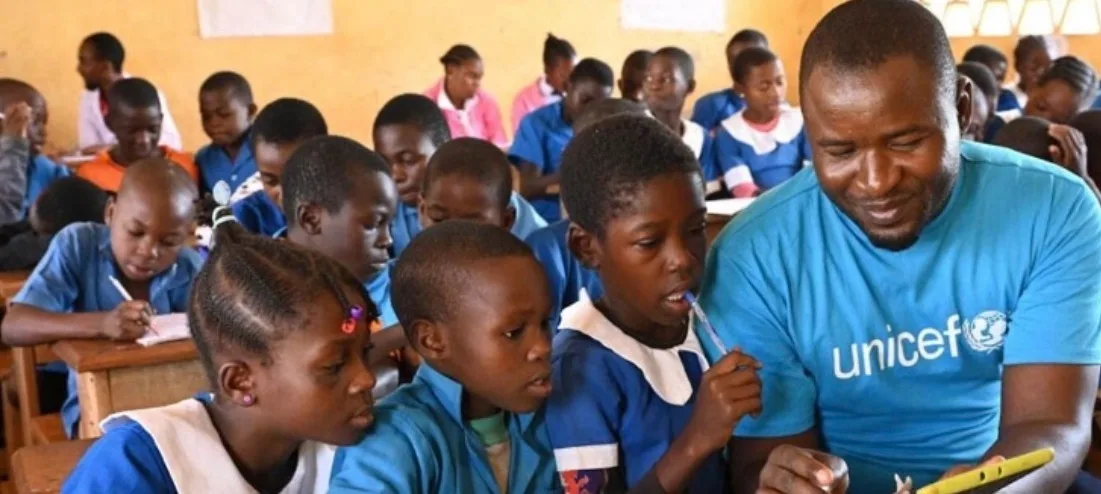
In Cameroon’s North-West and South-West regions, 223,749 children are currently out of school, while 2,463 schools remain non-operational. For those whose education has been interrupted by the crisis, UNICEF, with support from the European Union’s humanitarian aid and partners, is turning to accelerated learning to help them recover lost skills and prepare for a return to formal education.
A generation facing interrupted schooling
For thousands of children in Cameroon’s North-West and South-West regions, education has been disrupted for years. Conflict, displacement and the prolonged interruption of schooling have pushed many children away from classrooms and created significant gaps in their learning.
According to figures cited by UNICEF, 223,749 children are currently completely out of school across the two regions. The disruption also affects the education infrastructure, with 2,463 schools reported to be non-operational, including 2,005 in the North-West and 458 in the South-West.
Behind these figures are children whose educational journeys have been put on hold. Some have been displaced from their communities, while others have spent long periods without access to regular classes. Returning to school after such interruptions can therefore be difficult, particularly when children have fallen several years behind their peers.
The consequences can extend beyond missed lessons. Prolonged exclusion from education can affect children’s acquisition of basic skills and reduce their chances of continuing their studies. Restoring access to education therefore requires solutions adapted to children who have accumulated substantial learning gaps.
CARED as a bridge back to formal education
It is in this context that the Accelerated Curriculum for the Reintegration of Dropout Children (CARED) provides an alternative pathway. The program is designed for children who have missed extended periods of schooling and need to
recover essential knowledge before returning to the formal education system.
Rather than simply placing children back into classrooms without addressing what they have missed, accelerated learning allows them to work through key areas at a faster pace. Reading, writing, mathematics, science, technology and environmental education form part of the learning areas covered.
The objective is ultimately reintegration. The accelerated curriculum is intended to serve as a bridge between a prolonged period outside school and a return to regular education, giving children an opportunity to rebuild their academic foundations.
Aminatou, 10, is among those benefiting from this approach. After being displaced from Bamenda to Kumba in the South-West Region, her schooling was interrupted. Through CARED, she is now working to recover lost learning and prepare for a return to formal education. Despite the disruption, her ambition has remained unchanged: “I want to become a nurse.”
Keeping children’s ambitions alive
The program is supported by UNICEF, the European Union’s humanitarian aid and partners, as part of efforts to provide learning opportunities to children affected by crisis and displacement.
The approach has already allowed thousands of children to reconnect with formal education. UNICEF reports that 7,665 children were reintegrated into formal education in 2024 through accelerated learning interventions.
For children who have spent long periods away from school, the challenge is therefore not only to make up for missed lessons. It is also to prevent an interrupted education from becoming a permanent exclusion. By creating a pathway back to the classroom, CARED offers children affected by the crisis the possibility of resuming their studies and continuing to build the futures they imagine.