Following the recent floods in Limbe, the Cameroon Red Cross is strengthening community-based epidemic surveillance. Thirty-four volunteers and supervisors are being trained to detect, report and help prevent diseases with epidemic potential in affected communities.
Watching for health threats
As communities recover from the floods, health surveillance remains a key component of the response. The Cameroon Red Cross is strengthening the capacity of volunteers to identify potential health threats as close as possible to affected households.
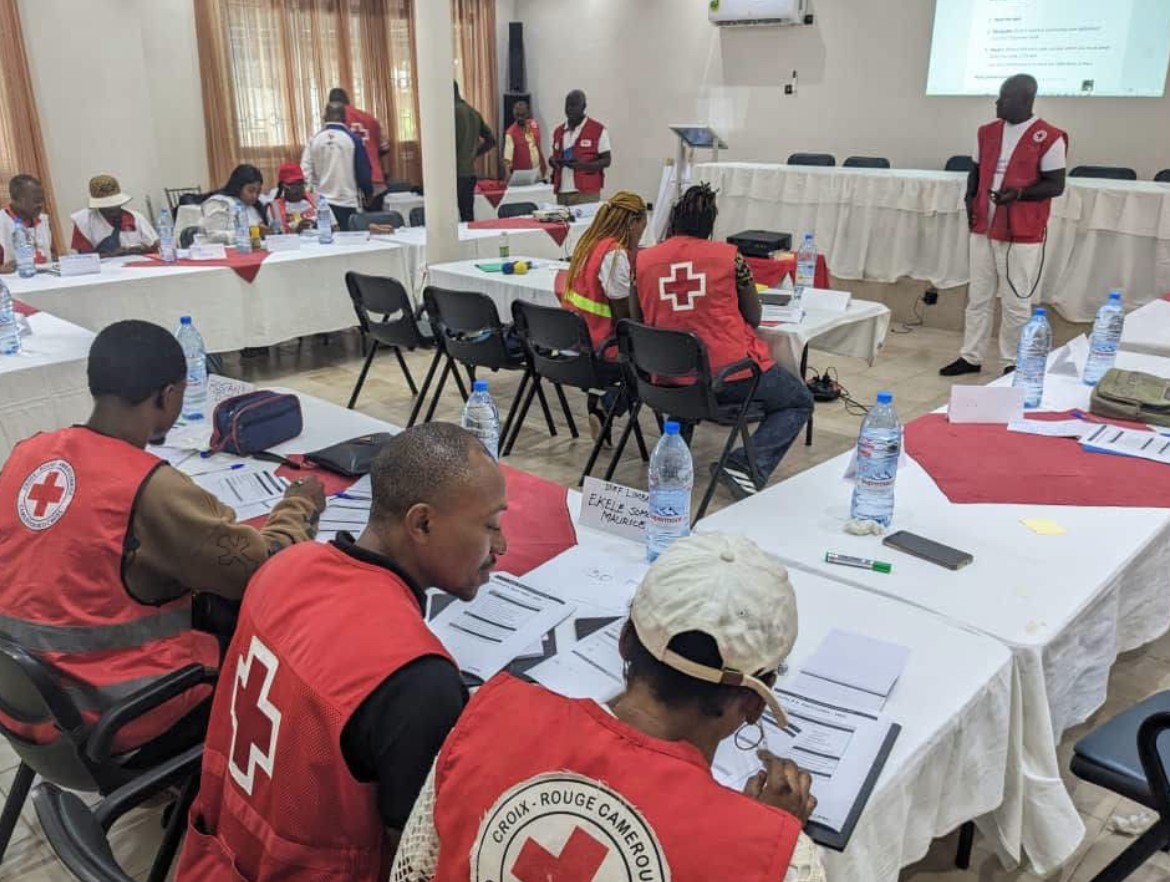
A total of 34 participants, including volunteers, supervisors, members of the Cameroon Red Cross local committee and facilitators, are taking part in an integrated training session on Epidemic Preparedness and Response in Communities (EPIC) and Community-Based Surveillance (CBS).
The objective is to improve the early detection and reporting of diseases with epidemic potential, while strengthening prevention efforts at community level.
The approach is based on a simple principle: trained community actors can help identify warning signs and transmit information rapidly, complementing surveillance carried out through health facilities. Their presence within communities also allows prevention messages to reach households directly.
From communities to the surveillance system
The Community-Based Surveillance component focuses on the identification and reporting of alerts using community case definitions.
Volunteers are trained to recognize signals that could indicate a potential outbreak and report them in real time by SMS through the Nyss platform. Supervisors are also trained to analyze and interpret the information collected.
This creates a link between affected households and the wider surveillance system. Instead of relying solely on cases reported through health facilities, community-based surveillance provides an additional channel through which unusual health events can be identified and communicated.
The system does not replace medical diagnosis. Its purpose is to ensure that relevant signals are detected and communicated quickly so that they can be assessed and, where necessary, trigger an appropriate response.
The training therefore combines technical knowledge with practical exercises, group work and community-oriented approaches. Volunteers are expected to understand not only what constitutes an alert, but also how to communicate health information appropriately within affected communities.
Building preparedness beyond the floods
The training also covers Epidemic Preparedness and Response in Communities. Participants are introduced to priority diseases, their symptoms, modes of transmission and prevention measures.
The program further addresses behavior change communication, Protection, Gender and Inclusion (PGI), the use of Epidemic Control for Volunteers tools, Community Engagement and Accountability, as well as community-based psychological first aid.
These complementary skills are intended to prepare volunteers not only to identify alerts, but also to communicate with communities, encourage preventive practices and provide basic psychosocial support during an emergency.
The initiative is being implemented under the Fako Floods DREF by the Cameroon Red Cross, with support from the International Federation of Red Cross and Red Crescent Societies (IFRC) and funding from the European Union Civil Protection and Humanitarian Aid.
For the affected communities, the training adds a health surveillance
component to the flood response, with volunteers positioned as a first line of community-level detection and prevention. By strengthening their capacity to identify and communicate potential threats, the operation seeks to ensure that surveillance remains as close as possible to the households most affected by the floods.