By revealing that the number of femicides for the first five months of 2026 alone already equals the total of 50 cases recorded for the whole of 2023, after an increase of 67 deaths in 2024 and 77 in 2025, the government exposes a geometric acceleration of the scourge.
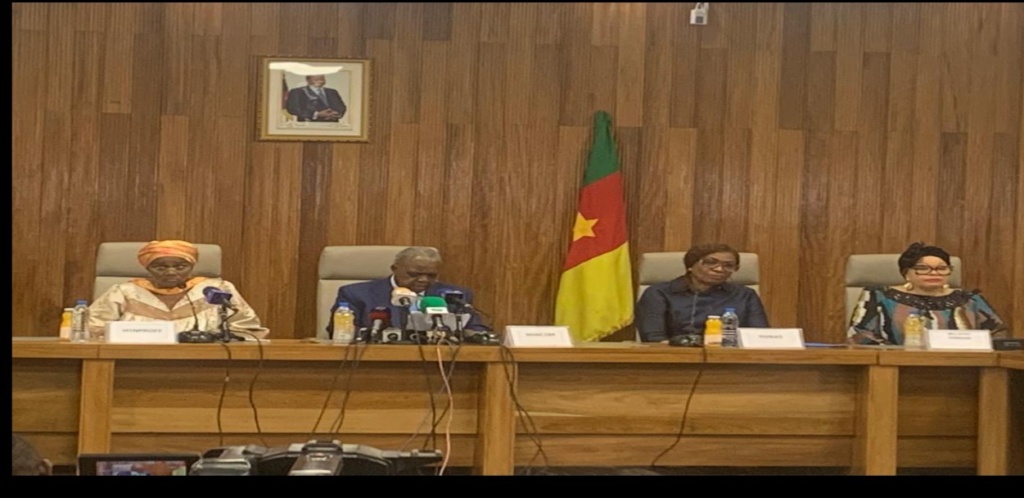
Their names were Mathis, Barbara, Carl, Kevin-Jones. They were three, eleven, seven years old, or barely old enough to say « mama. » Their names, recited like a funeral rosary by the Minister of Communication, René Emmanuel Sadi, chilled the auditorium of the Ministry of Communication. Facing them, a group of ministers, their faces grim, and journalists hanging on every word. On Monday, June 1, 2026, the Cameroonian government held a historic press conference, not to celebrate progress, but to confess, with supporting statistics, the inexorable rise of gender-based violence (GBV): femicides, infanticides, rape of minors. A « loss of humanity, » in the minister’s words.
It was René Emmanuel Sadi, Minister of Communication, who opened the litany of grievances. His tone was grave, his voice sometimes hesitant, as if each name were a stone he was placing on an invisible grave. « Little Andréa Kevin-Jones, 3 years old, in preschool, a victim of sexual abuse. Young Barbara, 11 years old, murdered. The murder of three children by their mother. » The list grew longer, merciless. Little Mathis, killed by a neighbor of his father. Carl État, 11 years old, found lifeless in a family home. A 3-year-old girl, raped and then murdered. A 7-year-old child, bound with chains by his sister in his bed.
With each name mentioned, the audience held its breath. These names, now public knowledge, are not linked by the grace of poetry, but by the horror of a shared root cause: domestic or institutional violence. « Most of these cases occurred within families, perpetrated by people close to the victims, or within institutions meant to protect children, » the minister emphasized, highlighting a systemic flaw.
The staggering figures: 50 femicides in five months
While the names are heartbreaking, the numbers are staggering. From the outset, René Emmanuel Sadi set the statistical scene for femicides. In 2023, 50 women were murdered. In 2024, 67. In 2025, 77. « And since the beginning of 2026, the trend has accelerated, » he emphasized. But it was the Minister for the Promotion of Women and the Family, Marie-Thérèse Abena Ondoa, who drove the point home. « In 2026, we have already recorded 50 cases of femicide. We are not even halfway through the year. » A deathly silence fell over the room. She clarified: « These figures represent only the visible part of the phenomenon. We are still unaware of the cases that go unreported, due to exhaustion, stigmatization, discouragement, or out-of-court settlements encouraged by precarious circumstances. »
She then presents a broader picture of gender-based violence in Cameroon, drawn from a recent university survey: 39% of women aged 15 to 49 report having experienced physical violence in the past fifteen years. 13% have been victims of sexual violence at some point in their lives. 44% of women have experienced sexual violence at the hands of an adult partner. And even worse: 7% of women who are pregnant or have been pregnant report having experienced physical violence during their pregnancy.
« A specific law on sexual violence is coming. »
Faced with this tidal wave, the government presented a series of measures, both past and future. Minister Abena Ondoa reiterated existing mechanisms: the national strategy against gender-based violence (GBV), action plans, awareness campaigns, gender desks in police stations, child desks in certain units, and the toll-free number
1503 (currently under repair). She also cited concrete figures: in 2025, 850 children (722 girls, 128 boys) who were victims of sexual assault received psychosocial support. And 155 members of the defense forces were trained in identifying violence.
But the most anticipated announcement came from the Minister of Social Affairs, Pauline Irène Nguene, who spoke in the same breath (the two ministers took turns at the microphone, sometimes making it difficult for the press to distinguish between them). « We are drafting a specific law on sexual problems. The process is very advanced. We hope this bill will reach Parliament in the next session. » This statement carried the weight of a promise. « If we have this specific law, we will see a difference in how these cases are handled, » she insisted.
In the short term, the government has set itself three priorities: monitoring and adopting this bill on GBV, strengthening the operational coordination and fight mechanism, and strengthening « the honest and humane system, » a euphemism for a justice system often criticized for its slowness.
The obstacles: impunity, security crises, low reporting rates
Without mincing words, Minister Abena Ondoa listed the structural obstacles. In ten points, she paints a picture of a system that is malfunctioning: insufficient access to free and confidential services, weak intersectoral coordination, and persistent security crises in the Far North, Northwest, and Southwest regions—areas where the law often gives way to force. Added to this are the impunity of perpetrators, the weak enforcement of existing laws, the discrepancy between national legislation and ratified international conventions, the chronic underfunding of the fight against gender-based violence, the low rate of victims reporting, and out-of-court settlements that bury cases.
“Every woman killed, every child shot and abused is an irreparable loss,” Pauline Irène Nguene emphasized. Then, quoting President Paul Biya at the 2002 United Nations conference on children: “There is no more worthy human cause than the defense and promotion of the rights and future of children, who are God’s inheritance.”
School, this second place of danger
The Secretary of State to the Minister of Basic Education, Dr. Vivian Asheri Kilo, addressed the families. “Beyond families, there are schools. Teachers are suffering. Children are suffering.” She recalled a recent case, that of the “three little girls, Joyce and Nawan,” without going into all the details, but with restrained emotion.
“The Ministry insists on special vigilance. Parents must know who they are entrusting their children to. They must accompany them and inform the school administration who is picking up and dropping off the child.”
She confirmed that « very drastic measures » had been taken against the establishment in question. She then called for an end to the taboo surrounding these crimes: « It is the public’s fear and reluctance to acknowledge these crimes that leads to their proliferation. We must stop this. How can we accept that we have to wait for the justice system to reach this point for the crime of a 3-year-old child? »
A call for collective mobilization; silence kills.
All participants concluded on a common note: the fight against gender-based violence is a collective endeavor. « It is up to everyone to play their part, whether it be the government, civil society organizations, religious groups, traditional authorities, or each individual citizen, » insisted René Emmanuel Sadi.
Pauline Irène Nguene issued a solemn appeal: “We do not trivialize violence against children. We do not hide it. We do not silence it, because silence protects the perpetrators and never the victims.” A message that resonates like a manifesto. Faced with the scale of the damage—50 femicides in five months, 850 sexually abused children expected to receive care by 2025, and these statistics are still incomplete—the Cameroonian government is breaking its silence. It remains to be seen whether the specific law, institutional reinforcements, and the injunction to “report” will be enough to stem the tide of gender-based violence. The audience at the Ministry of Communication left with names etched in their minds: Mathis, Barbara, Carl, Kevin-Jones. And the question that refuses to be silenced: how many more will there be before the next conference?
Elvis Serge NSAA