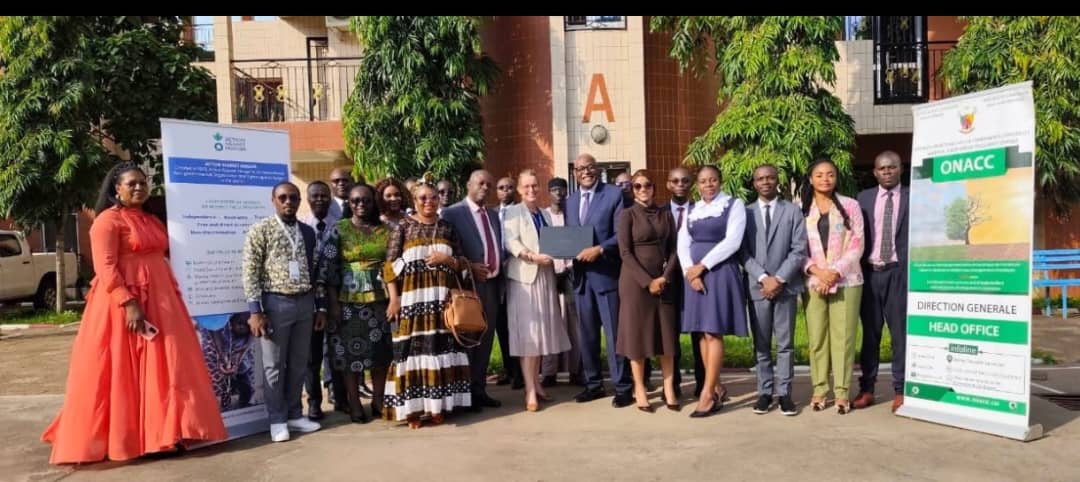
The National Observatory on Climate Change (NOCC) and Action Against Hunger have taken a new step in their partnership aimed at strengthening resilience and improving the well-being of populations affected by climate-related disasters, as the two institutions marked the handover of new information technology equipment in Yaoundé on June 15, 2026.
The NOCC has received a donation of computer equipment from Action Against Hunger (ACF), reinforcing an ongoing partnership focused on helping communities better cope with the growing impacts of climate-related disasters across Cameroon.
The handover ceremony took place on June 15, 2026, at NOCC headquarters in Bastos, Yaoundé. It was chaired by Professor Joseph Armathé Amougou, Director General of NOCC, in the presence of Andrea Lafosse, Deputy Country Director of Action Against Hunger, Patrick Mbomba Forghab, Deputy Director General of NOCC, and several department heads and technical staff from both institutions.
The donation forms part of a partnership agreement signed on May 8, 2024, between the two organizations. The collaboration is designed to strengthen resilience and improve the well-being of populations exposed to climate-related hazards, including floods, droughts, landslides and other extreme weather events that increasingly threaten livelihoods and infrastructure across the country.
Under the partnership, both institutions are working to improve the availability and use of climate information to support disaster preparedness, risk reduction and adaptation efforts. Officials say accurate climate data is becoming increasingly important as communities face more frequent and intense climate shocks linked to changing weather patterns.
The equipment donated by Action Against Hunger includes four HP laptop computers and a next-generation Micron Crucial external hard drive with a storage
capacity of six terabytes. While modest in size, the donation is expected to significantly enhance NOCC’s operational capacity by supporting the collection, processing, storage and analysis of climate data.
According to NOCC officials, strengthening these technical capacities will improve the institution’s ability to generate reliable climatological information for decision-makers, development actors and local communities. Such information plays a key role in anticipating risks, guiding adaptation strategies and supporting early warning systems that can help reduce the human and economic costs of disasters.
The partnership also reflects a growing recognition that climate resilience requires cooperation between scientific institutions, humanitarian organizations and public authorities. By combining technical expertise with community-based interventions, NOCC and Action Against Hunger seek to contribute to a more coordinated response to climate challenges affecting vulnerable populations.
In Cameroon, climate-related disasters continue to have significant consequences for agriculture, food security, water resources and livelihoods. Rural communities are often among the most exposed, particularly those that depend on rain-fed agriculture and natural resources for their survival. Improving access to reliable climate information is therefore considered a critical component of efforts to build resilience and support sustainable development.
For both organizations, the handover ceremony represents more than the transfer of equipment. It symbolizes a shared commitment to strengthening institutional capacities and ensuring that communities are better prepared to face climate-related risks. As the effects of climate change become increasingly visible, partnerships such as this one are expected to play an important role in protecting lives, supporting livelihoods and promoting long-term resilience across Cameroon.