
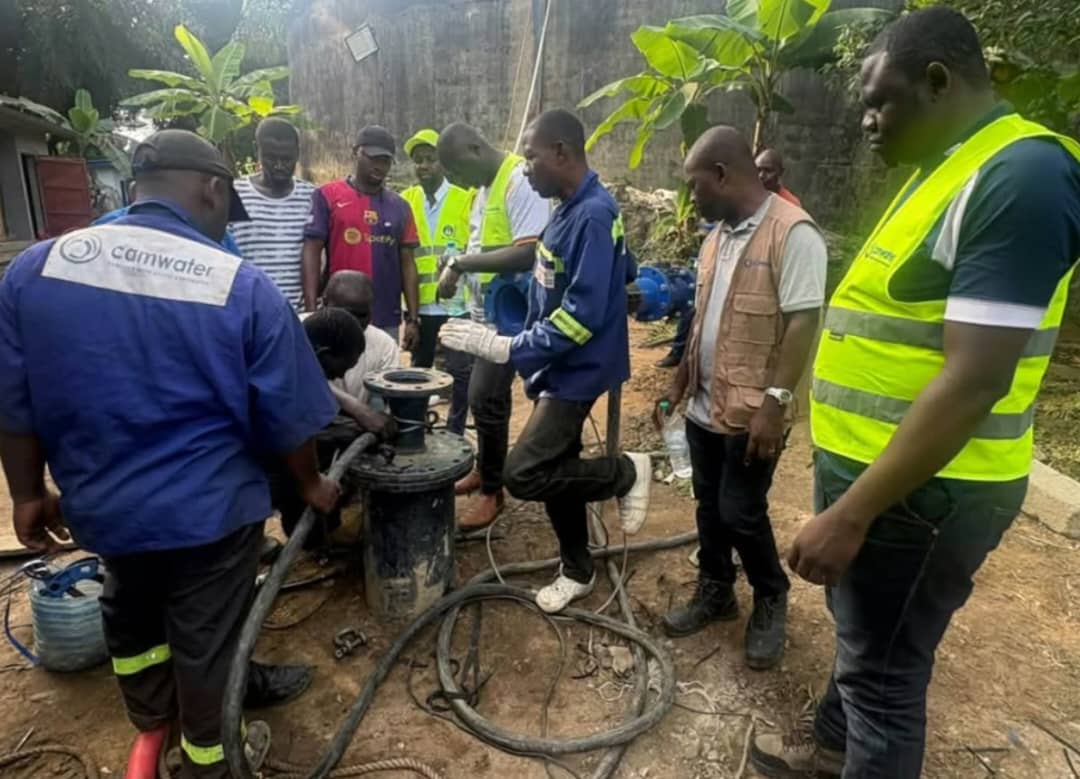
This extension will strengthen an existing fleet already comprising 12 industrial boreholes delivering 40,273 m³/day, in addition to the major Yato and Japoma complexes which supply 80% of the city’s total volume.
Their expected contribution is about 10,000 m³ of water per day. The Ndogbong and Koumassi boreholes are in the finalization phase. Work continues in Logbessou and Cité des Palmiers. Commissioning will be gradual, after technical checks and quality analyses. This schedule matters, as it determines the fate of neighborhoods where pressure drops are persistent.
The existing fleet is presented as having twelve functional industrial boreholes. The total installed capacity reaches 40,273 m³/day. The detailed figures notably align Koumassi A at 4,320 m³/day, Koumassi B at 5,620, Kotto Immeuble and Kotto Bloc at 2,280 each, Deïdo at 1,440, Bassa TP at 1,920, five Génie militaire boreholes from 1,920 to 4,032, Carrefour Maçon Bonamoussadi at 4,032, and Bonamoussadi Marché at 3,000. These volumes are not decorative. They speak to the dependence of many neighborhoods on local units.
The geography of production is just as telling. Urban boreholes account for 1/5 of network output. 4/5 of the total volume of drinking water consumed in the city comes from the Yato and Japoma complexes. Yato I and II weigh in at 150,000 m³/day. Japoma weighs in at 60,000 m³/day. The Japoma station is in the final phase of a major rehabilitation and extension program financed by the State of Cameroon and its development partners. The balance of power is clear:
the large complexes carry the bulk, the boreholes correct the blind spots.
Water quality is presented as a non-negotiable requirement. Before any injection into the network, the water from the new boreholes undergoes physicochemical, microbiological, and toxicological analyses. Additional checks are carried out by independent laboratories to verify compliance with current health requirements. The stated objective is to guarantee drinking water meeting World Health Organization standards.
The figures therefore say two things at once. The first is a dynamic: four boreholes, an additional 10,000 m³/day, an already installed fleet of 40,273 m³/day, and major complexes at Yato and Japoma. The second is a fragility: the boreholes represent only a fifth of network output, neighborhoods await gradual commissioning, and pressure remains a cruel indicator. In Douala, water is measured in cubic meters, but it is lived through taps that flow or tremble. The figure of 10,000 m³/day is a promise. The 40,273 m³/day already installed is a reminder. The 210,000 m³/day of Yato and Japoma is a dependence. And water quality is not negotiable.