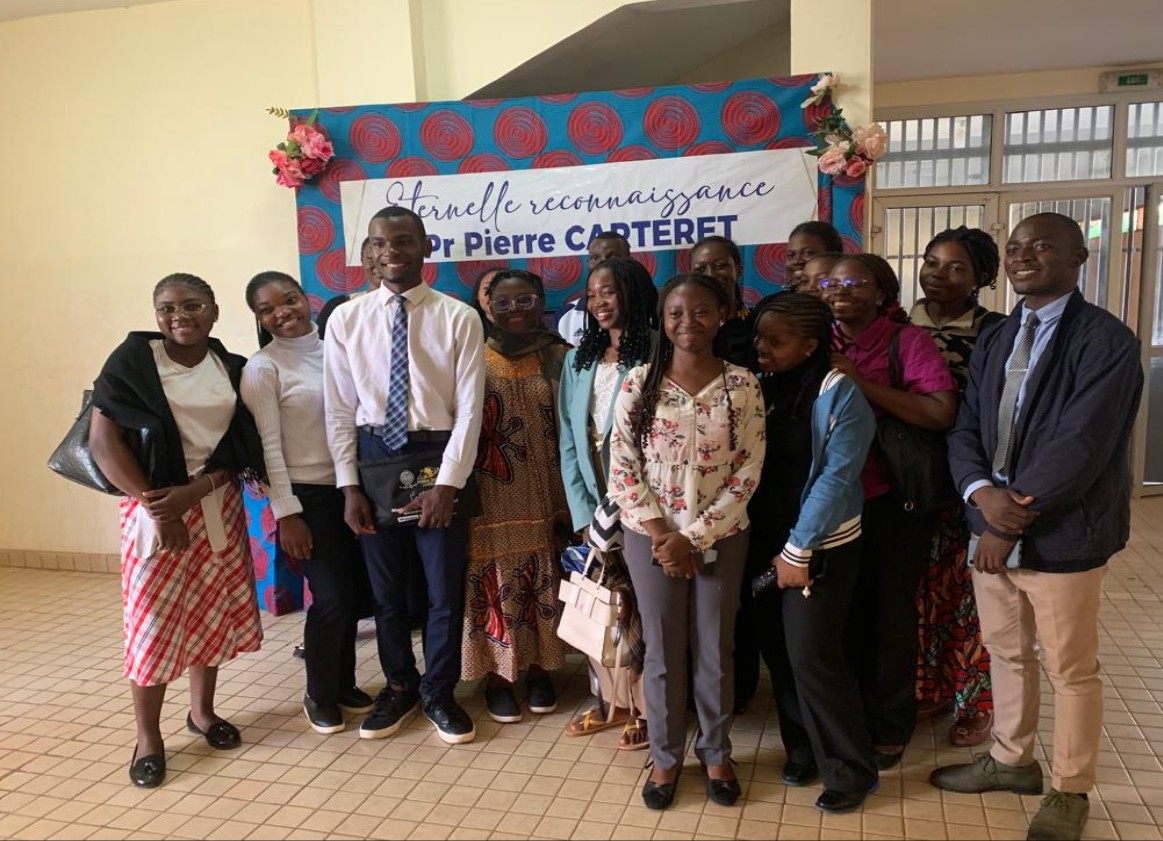
Aware that 21st-century diseases are no longer treated solely with surgery but also through the preservation of the ecosystem, the Eco-Health Club The Faculty of Medicine and Biomedical Sciences at the University of Yaoundé 1 brought together about fifty students around the « Climate Fresk » on April 29, 2026.
They spend seven years learning how to repair the human body. Listening to the lungs, auscultating the heart, deciphering fevers. But never, not once, have they been taught that the Earth, too, can fall ill. That its shivers, its sweats, its fury—devastating heat waves, deadly floods, murderous droughts—always, inexorably, end up contaminating their patients. For four hours, in an anonymous room at the Faculty of Medicine and Biomedical Sciences of the University of Yaoundé 1, about fifty students traded their stethoscopes for maps. The date was not chosen at random. On April 22, Earth Day, the Eco-Health Club, chaired by Fogueng Noah Bernard Junior, a fifth-year medical student, organized a workshop unprecedented in the faculty’s history. Not a theoretical lecture, but a participatory event revisited from a health perspective.
In the room, the maps are spread out like pieces of a giant puzzle. One depicts rising temperatures. Another, melting ice. A third, floods. A fourth, the proliferation of mosquitoes. And very quickly, the connection is made. The students, gathered around the tables, cease to be mere students and become investigators. Fogueng
Noah Bernard Junior, who is also a member of the student leadership council of the International University Network for Climate Action based in Laval, Canada, delivers the diagnosis bluntly: “Extreme heat reduces water consumption, which leads to kidney disease. High temperatures promote the proliferation of multi-resistant bacteria. Floods cause the spread of waterborne diseases such as cholera and typhoid fever.” Then he drives the point home: “Healthcare professionals are not yet sufficiently trained in the links between climate and human health.” Within the framework of the One Health concept, which is the interconnectedness of environmental health, animal health, and human health, health students must be made aware of this early on.
The workshop was led by Anne-Marie Magoueth Pulcherie, the local representative of the Soutenable association in Yaoundé. She explains the method: “It’s a collaborative and fun game that helps people understand the cause-and-effect relationships in environmental degradation. We start from the premise that environmental degradation is caused by human activities. There are causes, effects, and consequences that follow one another from the micro to the macro level. The cards can be read from bottom to top or from top to bottom.”
In the groups, the discussion is intense. The future doctors manipulate the cards, search for causal chains, hesitate, debate, and finally arrive at the answer. General medicine student Noa Marie-Joséphine testifies with surprising maturity: “What I learned were cause-and-effect relationships. We were shown, based on environmental factors, the immediate and underlying causes of human-induced phenomena. I decided to adopt a new lifestyle regarding waste management and resource use.” She even makes a direct connection to her future medical practice: “As a future healthcare professional, I understand that certain medications shouldn’t be prescribed to just anyone. The mortality and morbidity rates are high, but we must protect ourselves. I also learned that poor waste management can have an impact on human health. For example, the human-induced factors that cause the greenhouse effect can lead to flooding.” Stagnant water near poorly managed waste produces odors and is detrimental to health, especially since some vendors set up shop nearby and people consume these products.
Another participant, Amvouna Atangana Melchior, doesn’t hide his sincerity: « For me, the workshop was a bit complicated, but it was both fun and educational. It allowed us to learn about climate change, waste management, the problems of developing countries, and the impact of these factors on the health of populations, especially the most vulnerable. » He then offers an analysis that sums up the spirit of the workshop: « As a medical student, I clearly see the link between the
environment, human health, and the ecosystem. It’s the people who need action, because they are on the front lines. We need to raise awareness and educate them more. For example, deforestation leads to the loss of animal habitats. These animals migrate, which disrupts the food chain and ultimately impacts human health. »
The organizers compiled a list of the health consequences identified by participants. These are numerous and tangible: waterborne diseases such as cholera and typhoid fever, vector-borne diseases such as malaria, malnutrition and famine, trauma and mental health disorders related to disasters, respiratory illnesses caused by forest fires, and increased vulnerability of displaced populations. The chain of causality is inexorable: climate change, environmental degradation, a proliferation of health risks, and heightened vulnerability of populations.
Fogueng Noah Bernard Junior cites recent examples to support his point: “The forest fires in Canada last year were triggered by the summer drought. The episodes in California and Australia, massive fires that were difficult to control, required evacuations and humanitarian aid.” He adds that Cameroon is not spared: “The northern region is particularly affected by climate-induced displacement. Most NGOs are working there.” The workshop benefited from significant institutional support: the Ministry of Public Health, through the Directorate of the Economy and the Directorate for the Fight Against Epidemics and Pandemics; the Zoonoses Program housed within the Prime Minister’s Office; the International University Network for Climate Action; and the Health and Environment Laboratory, sponsored by the Ministry of Health.
The Eco-Health Club, with 63 to 65 members, operates thanks to membership fees (1,000 CFA francs at general assemblies) and sponsorships. The executive board, led by Fogueng Noah Bernard Junior until October 2026, comprises three vice-presidents, a general secretary, two deputy general secretaries, a communications officer, a treasurer, two committees, and includes three women, a sign of its commitment to gender balance. The club president makes no secret of his ambitions: “We organized scientific conferences on health and climate in 2022 and 2023, as well as campus clean-up operations. We hope to organize educational excursions to the Ecopark and participate in international bodies such as the COP. Young people have a role to play, a voice to be heard, and a unique method for contributing to global awareness of climate, health, and wellness issues. We are seeking institutional or financial support.” »
Elvis Serge NSAA