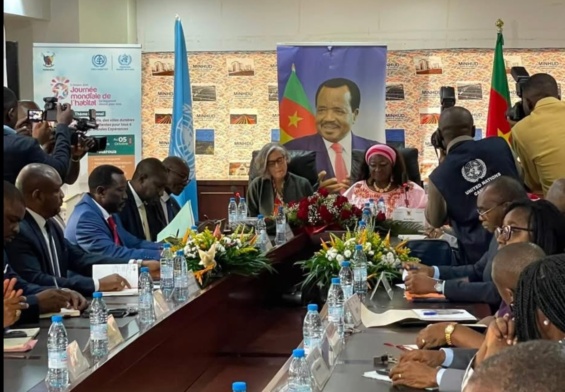
In New York, Cameroon demanded a global political and diplomatic response to viral hepatitis. Championed by the Minister of Public Health, Dr. Manaouda Malachie acting as the emissary of the President of the Republic, HE Paul Biya this call aims to break the silence surrounding this health tragedy and secure a dedicated UN summit in 2028.
At the 81st session of the United Nations General Assembly, Cameroon made a significant impact by raising a strong, resolute voice against a global health emergency that has been ignored for too long. Acting under the direct instruction of the President of the Republic, His Excellency Paul Biya, the Minister of Public Health, Dr. Manaouda Malachie, participated on September 21, 2026, in the 5th annual meeting of the United Nations Group of Friends for the Elimination of Hepatitis. The event served as a platform for forceful political and diplomatic advocacy aimed at breaking the silence and transforming international commitments into concrete actions by 2030.
An unacceptable paradox in the face of a global burden
In a forthright address, the head of the Cameroonian delegation highlighted a striking contrast: despite the existence of proven scientific solutions such as an effective hepatitis B vaccine, high-performance screening tools, and innovative treatments the human toll remains alarming, with nearly 287 million people living with hepatitis B or C and 1.3 million deaths occurring annually. Dr. Manaouda Malachie argued that this unsustainable burden has never received financial and political backing commensurate with its severity, even though it is inextricably linked to universal health coverage, blood safety, and liver cancer prevention.
Cameroon’s concrete progress: from the field to national strategy
In championing this cause internationally, Cameroon draws on measurable progress achieved domestically through a structured national response. This has resulted in an expanded care network growing from 21 to 65 accredited treatment centers as well as a significant increase in screening rates among pregnant women (404,192 tests performed in 2025, up from 312,280 in 2024) and the general population (rising from 245,296 to 336,400 people tested). This local momentum is complemented by the finalization of national care guidelines, the introduction of the hepatitis B birth-dose vaccine, free prophylaxis for pregnant women carrying the virus, and the upcoming prospect of integrating this care into the Universal Health Coverage package ensuring that no one foregoes treatment for financial reasons.
Towards a United Nations High-Level Meeting in 2028
For the Cameroonian government, the current challenge is no longer merely scientific but fundamentally political and organizational; this makes it essential to translate the ministerial declaration signed in May 2026 into a formal, binding process. Cameroon therefore urges Member States to support the draft resolution aimed at convening a United Nations High-Level Meeting in 2028 one that includes measurable targets, a rigorous accountability mechanism, sustainable financing, and reduced out-of-pocket costs to ensure affordable access to essential products. By reaching out to the WHO, the African Union, communities, and international partners, Cameroon reaffirms its absolute determination to make this resolution a driver of results, for as the Minister noted, « the time for silence is over. »
Reaction : « Garnering political support and funding »

« It is worth noting that this meeting of the ‘Friends of the United Nations’ group is taking place on the sidelines of the 81st UN General Assembly. The focus here is the elimination of hepatitis a ‘silent killer’ and a major public health issue. Cameroon, alongside three other nations, aims to highlight the fact that current funding for the fight against hepatitis is disproportionate to the scale of the disease.
That is why we want to bring this issue to the United Nations level: to garner political support and the accompanying funding needed to achieve the elimination of hepatitis by 2030. Cameroon has already made tremendous efforts in this regard. We have gone from 21 treatment centers to 65 today.
We have moved from high costs for hepatitis care to a system involving only modest payments. Furthermore, we intend to integrate the treatment of viral hepatitis specifically Hepatitis B into the Universal Health Coverage benefits package. This meeting aims to mobilize a global effort to combat and eliminate hepatitis by 2030; given that a vaccine and treatment options already exist, all that is missing is the political will and the necessary funding. »