
The National Office for Civil Protection (ONACC) forecasts heavy rainfall across much of Cameroon between September and November 2026. In Yaoundé, where urbanization is encroaching on the hillsides, the risks of flooding and landslides are raising concerns. The Nkomo tragedy has reignited questions about prevention and the protection of residents.
The rains expected in September, October, and November 2026 call for vigilance. In its 36thᵉIn its latest seasonal bulletin, the National Observatory on Climate Change (ONACC) forecasts heavy rainfall across most of the country. In the environmental sector, the institution specifically warns of risks of flooding, drowning, landslides, as well as lightning and strong winds.
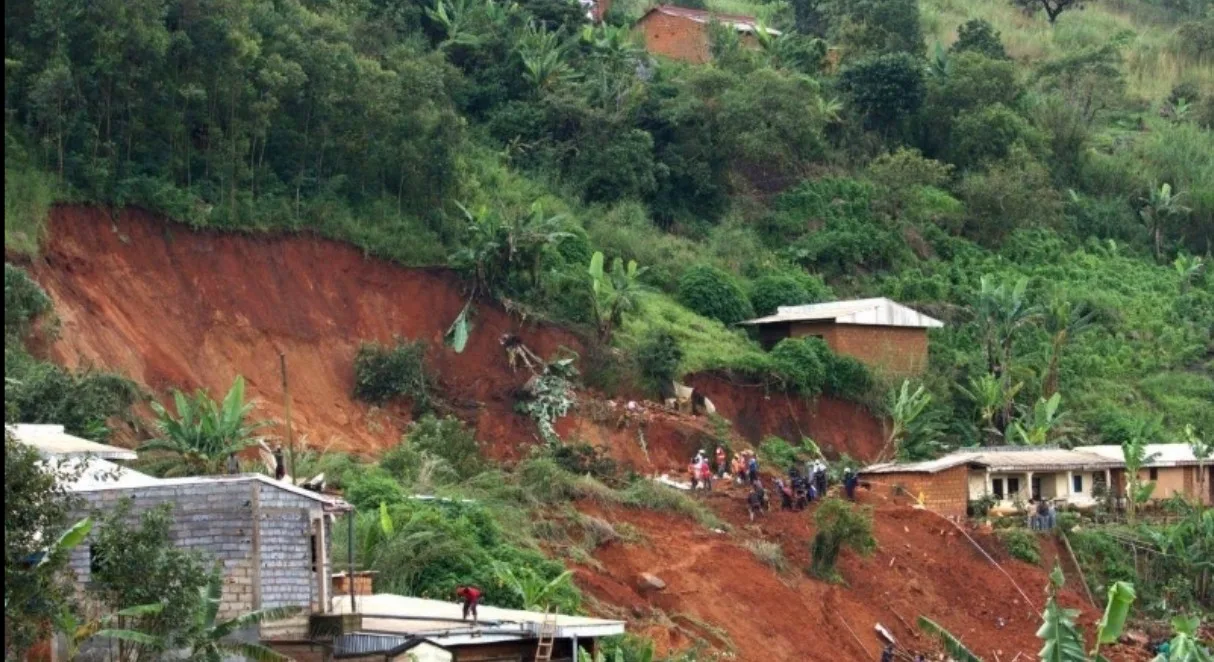
Yaoundé is among the areas at risk of flooding due to heavy rainfall and blocked drainage systems. These forecasts take on particular significance after the deadly landslide on September 16 in Nkomo, in the Yaoundé IV district, where four members of the same family reportedly lost their lives.
A city prone to landslides
Beyond this tragedy, the conditions of urbanization in the capital raise questions. For environmentalist Joël Jambong, landslides result from a combination of natural and human-induced factors. « Yaoundé is a city of seven hills, subject to an equatorial climate with double rainfall maximums, » he explains.
According to the expert, some slopes can exceed 20 to 30%, particularly in neighborhoods like Akok-ndoé, Mendong, and Mewoulou. Heavy rainfall saturates the soil, reduces its cohesion, and can trigger landslides.
In addition to these natural factors, there is deforestation, earthworks, and the
occupation of hillsides. Joël Jambong indicates that between 1965 and 1992, more than 3,000 hectares of forest were destroyed around Yaoundé for construction. He also mentions a reduction in vegetation cover in certain urban areas.
The disappearance of vegetation deprives the soil of root anchorage, while construction work alters natural water flows. « It’s a system with cumulative risks, » the environmentalist summarizes.
Building in vulnerable areas
Behind the development of hillside settlements lie economic and social realities. The cost of developed land, demographic pressure, and a lack of affordable housing can push some families to seek less expensive plots.
According to Joël Jambong, building on slopes without geotechnical studies or stabilization measures constitutes a vulnerability factor. He cites, in particular, that excavating the land, adding earth to fill it in, and covering the ground with concrete or tar can increase the risks of landslides and flooding.
The expert also states that 54% of houses built on slopes in Yaoundé VI have no preventative measures.
The situation raises a major social question: how to reconcile the housing needs of the population with the imperatives of security and urban planning?
A cascade of health consequences
Rain-related disasters are not limited to human and material losses. The destruction of latrines, water points, and sanitation systems can lead to water contamination and increase the risk of diarrheal diseases.
Damaged roads can also complicate access to healthcare facilities and slow down rescue efforts. Added to this are the psychological traumas associated with the loss of a loved one, a home, or livelihoods.
From an environmental perspective, landslides accelerate erosion, destroy vegetation and can carry mud and waste into waterways.
Strengthen prevention
To reduce these risks, the environmentalist suggests identifying hazardous areas, monitoring rainfall, and redesigning drainage ditches to facilitate water runoff. He also emphasizes the need for better planning of construction, replanting trees, and providing assistance to residents living in exposed areas.
ONACC alerts are a tool for vigilance, but their effectiveness also depends on the ability of the authorities to inform residents and take preventive measures.
In Yaoundé, preventing environmental disasters requires an approach that combines urban planning, population protection, and public health. Anticipating risks also means reducing the human consequences of disasters.