
From the African bush elephant to the Patagotitan, via the giraffe and the Paraceratherium, a journey into the realm of animals that push the boundaries of size and weight. A story of adaptation and fragility.
There are animals that, simply by standing tall, change the scale of the world. Their shadow alone is enough to remind us that the Earth has known, and still knows, life forms capable of defying imagination. The African bush elephant, the giraffe, but also vanished titans like the Patagotitan, the Argentinosaurus, and the Paraceratherium, make up a gallery of records that fascinates as much as it questions. Behind every weight, every height, and every length lies an evolutionary history, an extreme adaptation, and a response to ecological constraints that have shaped out-of-the-ordinary silhouettes. A journey into the realm of giants, from the heaviest to the tallest, from the longest to the most imposing.
The current kings: the elephant and the giraffe
Among living animals, the African bush elephant (Loxodonta africana) reigns supreme over the podium of terrestrial gigantism. It is the largest and heaviest living land animal. An adult male can stand up to 4 meters tall at the shoulder and weigh on average between 6 and 7 tonnes. These figures alone induce vertigo. Imagine a six-tonne mass moving with surprising agility, capable of covering dozens of kilometers a day, modulating its diet according to the seasons, and interacting socially with rare complexity. The elephant is not just a giant: it is an ecosystem architect, a gardener of the savanna, an animal whose presence structures habitats. Its trunk, an extension of the nose and upper lip, contains over 40,000 muscles. Its tusks, ears, and feet: everything about it is designed for carrying, smelling, communicating, and regulating body temperature. The record weight is therefore not an anomaly. It is the product of a long evolutionary history.
Beside it, the giraffe (Giraffa camelopardalis) plays in a different category. It holds the height record among all living animals. It can reach nearly 5.8 meters in height thanks to its long neck, yet it remains much lighter than the elephant, weighing around 1.2 tonnes. The giraffe is the embodiment of verticality. Its neck, composed of seven cervical vertebrae—the same number as in humans but considerably elongated—allows it to reach the highest foliage, where food competition is less fierce. Its massive heart must pump blood all the way to its brain, located several meters above the ground. Its blood pressure is among the highest in the animal kingdom. And yet, it retains an elegance that contrasts with its disproportion. The elephant impresses with its mass, the giraffe with its verticality. Two records, two strategies, two ways of being a giant.
The vanished titans: Patagotitan, Argentinosaurus, Paraceratherium
But the history of life on Earth does not stop at the animals we can still observe. It spans millions of years and has produced giants of another scale. The Patagotitan (Patagotitan mayorum), a herbivorous dinosaur discovered in Argentina, is often cited as the largest ever found. It measured about 37 meters in length with an estimated weight of 70 tonnes. Seventy tonnes. That is more than ten times the weight of an adult elephant. Such an animal, rearing up on its hind legs, would have dominated the canopy. But the Patagotitan is not alone in this category. The Argentinosaurus (Argentinosaurus huinculensis), a South American titanosaur, disputes the absolute record with the Patagotitan. Paleontologists estimate its length between 30 and 40 meters and its weight between 70 and 80 tonnes, although its fossil bones are less complete. Uncertainty remains because fossils are fragmented, but estimates converge on spectacular proportions. These two dinosaurs remind us that gigantism was once pushed to levels that current mammals have never reached.
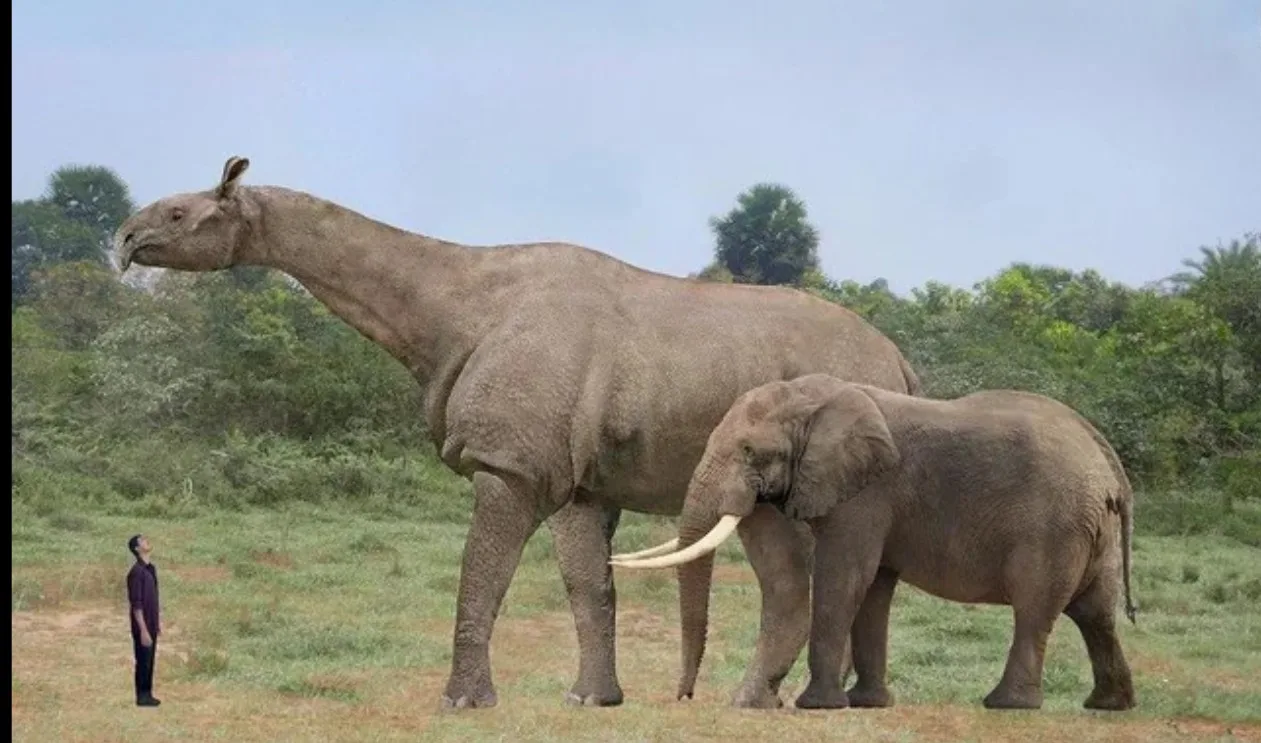
Then there is the Paraceratherium. This was not a dinosaur, but a mammal. It is the largest land herbivorous mammal that ever existed, long after the disappearance of the dinosaurs. This giant cousin of the rhinoceros stood nearly 5 meters tall at the shoulder and weighed about 15 to 20 tonnes. It lived in Asia around 30 million years ago and occupied an ecological niche comparable to that of modern elephants, but on a larger scale. The Paraceratherium shows us that gigantism was not exclusive to dinosaurs. Mammals too managed, at one time, to produce colossal forms. Its disappearance, like that of the other giants, remains linked to climate change, shifts in vegetation, and evolutionary constraints.
A lesson in humility
What is striking in this gallery of giants is the diversity of solutions found by evolution. The elephant relies on mass and robustness. The giraffe on height and relative lightness. The Patagotitan and Argentinosaurus on absolute length and weight. The Paraceratherium on a compromise between size and mobility. Each of these animals reminds us that nature has no single blueprint, but an endlessly renewed capacity for adaptation.
And while the dinosaurs have vanished and the Paraceratherium has died out, the elephant and the giraffe are still here. But for how long? Human activities, habitat destruction, poaching, and climate change weigh heavily on these giants. A record size does not protect against fragility. On the contrary, it may make them more vulnerable. Because an animal that needs vast spaces, abundant resources, and a long time to reproduce is more exposed to disturbances. Today’s giants are witnesses to an ancient history, but their future depends on our choices. Admiring them also means committing to protecting them. For greatness is not measured solely in meters and tonnes. It is also measured by the ability to coexist. E.S.N