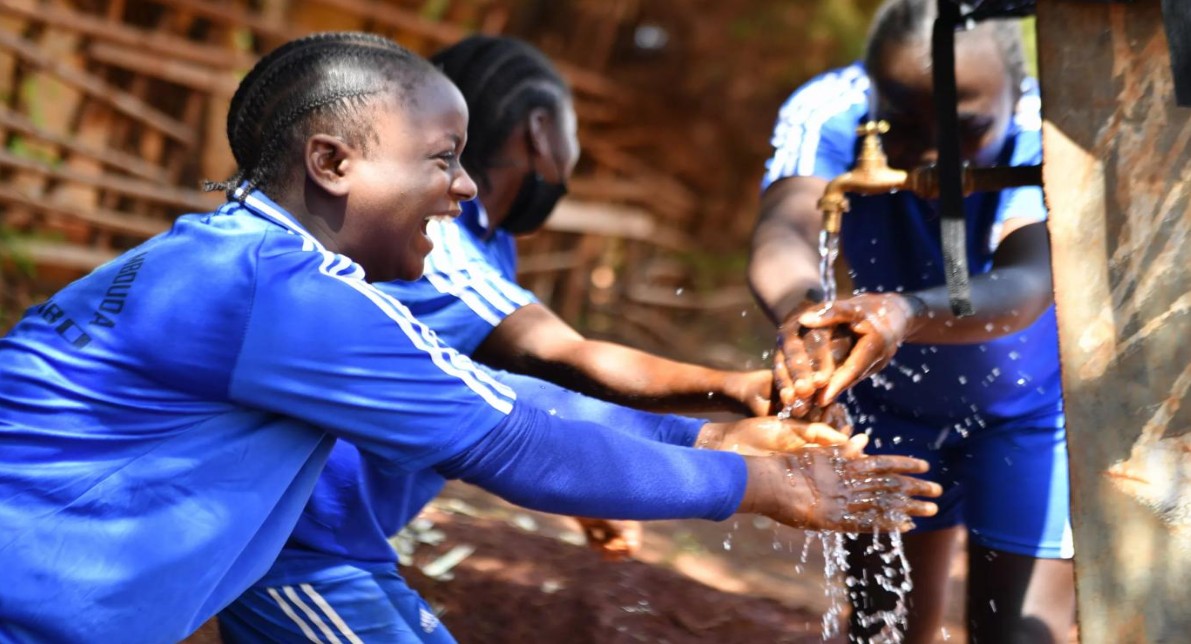
In Cameroon, 17% of girls regularly miss school due to inadequate menstrual hygiene management facilities, while diarrheal diseases cause more than 7,000 deaths per year, representing 16% of mortality among children under five.
Furthermore, infrastructural barriers deprive nearly 200,000 children living with disabilities of access to WASH (Water, Sanitation and Hygiene) services.
The celebration of the Day of the African Child on June 16, 2026, under the theme: « Ensuring universal access to water, sanitation and hygiene for every child in Africa ».
In the outskirts of Yaoundé, children rise before dawn to walk for miles in search of drinking water. To the east, in the Motcheboum camps, the morning mist envelops the huts in a cathedral-like silence, occasionally broken by the cough of a feverish child. To the west, in the Mifi region, internally displaced mothers scan the horizon, watching for the passage of a familiar figure who might bring them water. On June 16, 2026, Cameroon celebrates the Day of the African Child, established in homage to the Soweto student uprising of 1976, where 12-year-old Hector Pieterson became a global symbol of the struggle against the imposition of Afrikaans. Nearly half a century later, the struggle has changed, but the urgency remains the same. Under the theme « Ensuring universal access to water, sanitation and hygiene for every child in Africa », the Human Rights Commission of Cameroon (CDHC), created by the law of July 19, 2019, published a statement that paints an uncompromising picture of a country where children’s rights are violated both by the lack of infrastructure and by criminal violence that continues to
worsen.
The convergence of crises is striking. The Commission on Human Rights (CHR) recalls that the preamble to the Cameroonian Constitution of January 18, 1996, states in its 21st paragraph that « everyone has the right to a healthy environment, » thus enshrining sanitation as an essential component of constitutional law. Yet, the reality is quite different. According to data relayed by the Commission, access to drinking water remains limited to approximately 70% of the population, with marked disparities between urban areas (82%) and rural areas (52%). Only 43% of the population has access to basic sanitation facilities, with an abysmal gap between urban (58%) and rural (22%) areas. Behind every percentage point, there is a child who spends hours searching for water, a young girl who drops out of school for lack of decent toilets, a family that drinks contaminated water. Women and girls often spend more than 30 minutes a day fetching water, sacrificing their education and health. In Cameroon, 17% of girls regularly miss school due to inadequate menstrual hygiene management facilities, while diarrheal diseases cause more than 7,000 deaths annually, accounting for 16% of mortality among children under five. Furthermore, infrastructural barriers deprive nearly 200,000 children with disabilities of access to WASH (water, sanitation, and hygiene) services.
The CDHC observes that climate change exacerbates this water vulnerability through the degradation of infrastructure and the contamination of groundwater. Furthermore, Boko Haram incursions in the North and the crisis in the Northwest and Southwest exacerbate these disparities, causing significant internal displacement and a continuous influx of refugees from Nigeria and the Central African Republic.
The Commission certainly welcomes the efforts of the public authorities, particularly the National Water Policy adopted in 2019 and launched on April 11, 2025 in Yaoundé under the auspices of the Ministry of Water and Energy (MINEE) with the support of UNICEF. It also welcomes the strategic roundtable of the National Water Compact (2026-2030) held in April 2026 with the support of the World Bank, the EU and the IFC, as well as the projects of CAMWATER and the CGCOC Group to rehabilitate the networks of 10 cities. The CDHC highlights field interventions, such as the three-year KOICA-UNICEF project in the East, the press trip on May 28, 2026 to Bertoua for early childhood, and the framework agreement signed on April 17, 2026 in Maseru (Lesotho) with the African Committee of Experts to strengthen accountability.
But the declaration also addresses another equally deadly scourge: the alarming resurgence of infanticide, filicide, female genital mutilation, and domestic violence.
The Commission is concerned about this reversal of the family’s role, which should be the primary source of affection. In response to this barbarity, the Commission welcomes the joint press conference held on June 1, 2026, in Yaoundé, co-hosted by Ministers René Emmanuel Sadi (Communication), Marie-Thérèse Abena Ondoa (Minister of Women’s Empowerment and the Family), and Pauline Irène Nguéné (Social Affairs), announcing a coordinated state response. This emergency also brought together the CDHC and the MINPROFF on April 10, 2026 to promote the green lines 1523 and 116. In addition, during the UN Universal Periodic Review on March 26, 2024, Cameroon accepted 220 recommendations, three of which require accelerating the adoption of the Child Protection Code and conducting extensive health awareness campaigns.
For the Canadian Human Rights Commission (CHRC), the time for rhetoric is over. It formally recommends that the Government, Parliament, and the Judiciary implement an absolute zero-tolerance policy through expedited prosecutions and exemplary criminal sanctions against perpetrators of crimes. Specifically, it calls on the Ministry of Water and Energy (MINEE) to strengthen community water infrastructure; the Ministry of Basic Education (MINEDUB) and the Ministry of Secondary Education (MINESEC) to accelerate the construction of modern, inclusive, and separate latrines; the Ministry of Public Health (MINSANTÉ) to intensify hygiene and handwashing campaigns; and the Ministry of Social Affairs (MINAS) to ensure the development of infrastructure adapted for children with disabilities. It also calls on the Ministry of Development, Local Authorities, and Civil Society Organizations (CSOs) to intensify civic education for the preservation of infrastructure.
The Commission reaffirms its commitment to conducting inquiries, investigative missions, and addressing complaints through its toll-free number, 1523. The 2026 Day of the African Child is a stark reminder of the inequalities that exist. For the child in Doumaintang in the East who walks for miles, for the young displaced girl in Maroua deprived of privacy, the fight for water and protection is a fight for survival. Today, children in Cameroon are asking for water, toilets, soap, and security for a dignified life.