

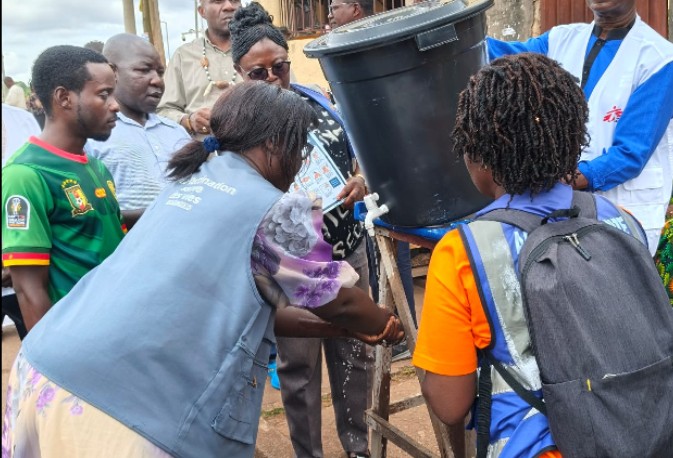
On September 21, 2026, World Cleanup Day mobilized Doctors Without Borders (MSF) and the Djoungolo health district to step up the fight against cholera through sanitation efforts and hygiene education.
Marked on Monday, September 21, 2026, World Cleanup Day took on particular strategic importance in the Cameroonian capital. Centered on the evocative theme « All Together for Mfoundi, » this initiative is an integral part of the sustainable cholera prevention project being implemented in the Djoungolo health district with the invaluable support of Doctors Without Borders (MSF). A major field visit made it possible to assess the sanitation measures taken to stave off epidemics.
A close look at municipal sanitation efforts
Community mobilization focused on four key sites in the Mfoundi division. A significant first stop was the Nylon neighborhood in Bastos, where the official delegation saw firsthand the dredging and landscaping work on the Tongolo River—expertly carried out by His Majesty Eric François Bikai, 3rd-class Chief of Nlongkak II, and his teams. “We worked on this for over two hours… The goal is to ensure water can flow freely to prevent flooding and keep disease vectors—specifically cholera—at bay,” noted His Majesty Eric François Bikai, highlighting the existence of a local hygiene day known as “Clean Tuesday,” established to maintain the sanitation momentum in the area.
However, the delegation’s tour also revealed some concerning problem areas. In the Tongolo neighborhood, numerous hygiene and sanitation issues were identified, highlighting the persistence of risky behaviors. The situation proved even more alarming at the Elig Edzoa market, where a massive garbage dump coexisted intolerably right in the heart of the trading area. The visit concluded at the Mfoundi market, underscoring the urgent need to sustain civic education efforts.
A strategic alliance between prevention and behavioral change
Beyond operations to clear drains and riverbanks, the event placed a strong emphasis on raising public awareness through WASH demonstration booths. Market-goers were introduced to rigorous personal and food hygiene techniques.
Alain Kouamen, a local resident encountered at the site, spoke about the impact of these practical workshops: « I learned that simply washing one’s hands isn’t enough; you have to scrub between the fingers, wash the thumb and wrist separately, and rinse using only running water. These are small but valuable details for avoiding contamination ».
Institutional and humanitarian stakeholders agree on the need to keep up the momentum. According to Ms. Pyssang Maidoukoula, head of the Djoungolo health district, « The fight against cholera is an arduous battle that requires a shift in mindset. We must not draw of raising awareness hand-in-hand with the community. » This commitment is shared by Frida Tebere of MSF, who notes that controlling filth remains the surest defense against the spread of the virus.
On the municipal front, Caroline Mbang, Head of the Health and Social Action Office at the Yaoundé I Town Hall, announced the upcoming launch of a pre-collection service using tricycles to serve narrow areas inaccessible to Hysacam trucks, thereby strengthening the public sanitation chain. Through this synergy between administrative authorities, local governments, health stakeholders, and the public, Yaoundé aims to achieve a lasting reduction in epidemic threats.
