
Resistant to thirst, cold, and thorny plants, the camel impresses. Yet its productivity drops without quality feed, and its breeding requires adapted skills and care.
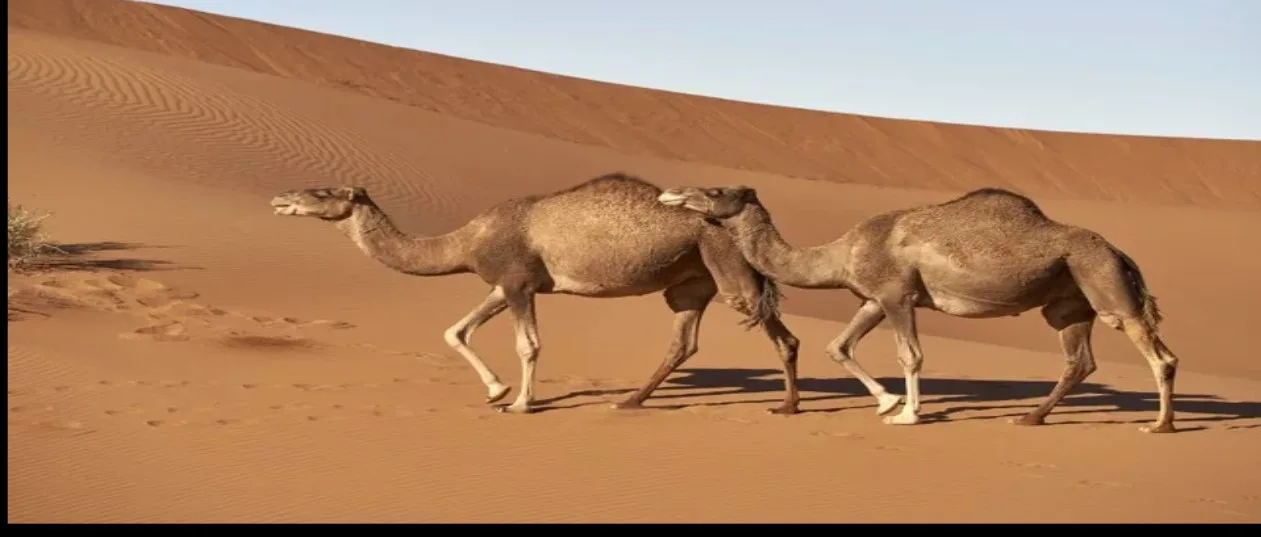
It moves where the road fades, where sand swallows tracks, where water is scarce and the sun merciless. The camel, and more broadly the camelid, is one of those creatures that nature has endowed with an extraordinary capacity for adaptation. But behind this image of robustness lies a more nuanced reality, made of remarkable assets and very real limits. For while the camel is a desert survivor, it is no miracle animal, and those who breed or exploit it know this well.
A physiology tailored for extremes
The camel’s primary asset is its resistance to climate. It withstands intense heat as well as freezing cold—down to minus 40 degrees Celsius for the two-humped Bactrian camel, thanks to its thick winter coat. This ability to live in environments few animals could endure makes it a precious ally in arid and steppe zones. To this is added a remarkable autonomy in water and food. It can survive long days without drinking, tolerate severe dehydration, and absorb large quantities of water very quickly when the opportunity arises. Its humps, often misunderstood, do not store water but fat, which provides energy during times of scarcity. A vital reserve that helps it get through the most difficult moments.
Its undemanding diet constitutes another major advantage. Where other ruminants refuse to browse, the camel makes do with thorny plants, dry grass, and neglected vegetation. Its adapted mouth and excellent digestion allow it to make the most of what nature offers at its most ungracious. This capacity to utilize marginal resources considerably reduces pressure on pastures and crops. In terms of loads and transport, the camel is also a powerful animal, capable of carrying heavy loads and covering long distances over difficult terrain—sand, steppes, or rugged relief. Finally, it produces multiple resources: milk, meat, and highly valued wool or hair, the quantity of which can reach up to thirty kilos.
Limits that temper the romanticized image
But the camel is not without weaknesses, and breeders know it. The first limit concerns its performance under poor nutrition. Admittedly, it survives on little, but feed of too poor quality causes its productivity to plummet—whether in terms of milk yield or growth—and affects its fertility. In other words, surviving does not mean producing. This is a fundamental distinction
for those planning profitable breeding.
Its slow reproduction constitutes another constraint. Gestation is long, lasting twelve to fourteen months, and females generally produce only one calf every two years. In a breeding context, this pace demands patience and complicates the rapid expansion of herds. Building a herd takes time, and this biological temporality cannot be negotiated.
The animal’s temperament, next, requires true mastery. Usually calm, the camel can prove stubborn, unpredictable, or aggressive, particularly males during the rutting season. It can bite if poorly handled. This demands skills, vigilance, and a relationship of trust with the animal. The camel is not mere livestock: it is a partner that commands respect. Its geographical adaptation is also specific. It is not built for humid or tropical climates. It is strictly tied to arid, semi-arid zones or cold steppes. Transplanting a camel to an unsuitable environment compromises its health and productivity.
Finally, modern maintenance comes at a cost. To optimize its production—dairy or otherwise—intensive or semi-intensive farming requires veterinary management and specific nutritional supplements. One thus moves away from the traditional model, with all its financial and technical implications. The camel, animal of extremes, remains above all an animal of context. It excels where conditions are harsh, but it cannot be reduced to a simple production instrument.
A wealth, provided it is understood
Thus, the camel embodies a dual reality: that of an extraordinarily adapted animal capable of transforming hostile environments into living spaces, and that of an animal with very real requirements whose breeding cannot be improvised. Preconceived notions die hard, notably the idea that the animal can make do with almost nothing. The truth is more subtle: the camel survives on little, but to produce, it needs attention, care, and adapted management. Between fascination and pragmatism, the camel continues to teach us something essential: resilience does not exclude fragility, and an animal’s greatness is measured not only by its capacity for survival, but also by the way humans know how to accompany it.