While more than 80% of the poorest Cameroonians are aware that healthcare is free for children and pregnant women, more than half of them continue to pay for their treatments and tests because of stock shortages or refusal by medical staff.
There are mornings when the mist of eastern Cameroon envelops the indigenous camps of Motcheboum in a cathedral-like silence, a silence occasionally broken by the muffled cries of a feverish child. At the other end of the national triangle, under the already scorching sun of Maroua, internally displaced mothers scan the horizon, watching for the passage of a familiar figure capable of deciphering the mysteries of this invisible illness that is decimating their families. For decades, these so-called vulnerable populations have been subjected to public health policies as distant statistics, passive targets inscribed in dusty registers. But a silent revolution is underway. A revolution not driven by grand ministerial speeches, but by the power of rediscovered voices and community data. Community-led monitoring is transforming these faces of precariousness into true sentinels of their own health destiny. Through the Malaria Equity Access initiative, led by Impact Santé Afrique, the fight against malaria in Cameroon is undergoing a paradigm shift. It is no longer simply about distributing survival tools, but about building genuine health citizenship, where the feedback of a pregnant woman with a disability or an orphan of Mifi is as valuable as the assessment of an international expert. The figures for the first quarter of 2026 tell this story with remarkable force, blending spectacular victories with persistent challenges that serve as a reminder that the path to health sovereignty remains fraught with obstacles.
The geography of salvation and the trap of mobility
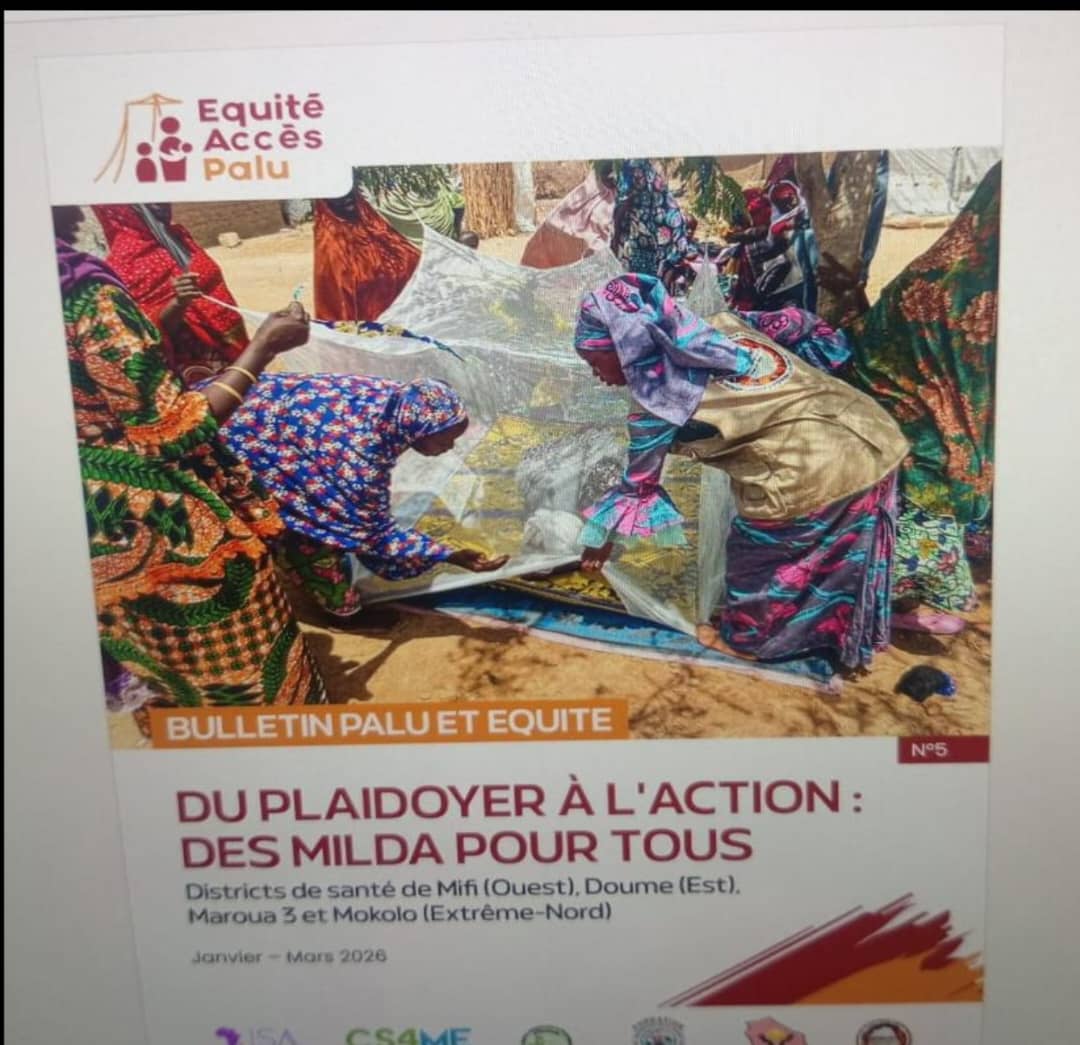
When you delve into the raw data collected between January and March 2026, your eye is immediately drawn to a performance that borders on institutional perfection. The large-scale mass distribution campaign for long-lasting insecticidal nets, launched at the end of 2025, has left a bright mark on the statistics. Imagine a nylon shield stretching across the country, reaching more than 19 million people. The figures, segmented by community-based mechanisms, reveal heights of equity that were thought unattainable. One hundred percent of targeted orphans received their nets, while pregnant women boast a coverage rate of 97.3%. Among caregivers of children under five, the rate reaches 92.6%. Overall, 93.3% of women and 90.5% of men from the most vulnerable groups are now sleeping protected. In the Far North, the success takes on the air of a popular triumph with an almost absolute coverage of 99.5% in Mokolo and a perfect score of 100% in Maroua 3.
However, this well-oiled machine breaks down as soon as one ventures into more complex access areas. In Doumé, in the Eastern region, the coverage rate plummets to 77%, while in Mifi, in the West, it stagnates at 86.5%. The reason for this decline in Doumé is not a shortage of supplies, but a profound misunderstanding of local anthropological realities. In the village of Bonando, in the heart of the Motcheboum health zone, distribution teams found empty huts. Nearly 57.1% of those not served were absent due to seasonal migrations, and 40.8% were simply never reached by the official mobile clinics. This is a stark demonstration that a standardized public health strategy, however generous, always founders on the realities of nomadic life. For protection to be total, science must learn to move in step with the seasons and the migrations of those it claims to save.
The sham of free access and the cry from the ground
The heart of the problem with our healthcare system lies in the gap between decrees signed in the air-conditioned offices of Yaoundé and the reality of rural health centers. Data from the first quarter of 2026 highlights an untenable paradox. On the one hand, information is circulating. Eighty-one percent of vulnerable populations are well aware that malaria treatment is completely free for children under five, and 77% of pregnant women know their right to free medical care. On the other hand, the financial reality is quite different. Fifty-two percent of vulnerable people interviewed had to pay for their malaria treatment, and 53% paid for a simple diagnostic test.
When community investigators ask these mothers and fathers why they paid despite
the official free healthcare program, the responses resonate strongly, contradicting the reassuring narratives. For 39% of respondents, payment was demanded due to a flat refusal by healthcare staff to provide free care. For 27%, chronic shortages of essential supplies rendered the free program meaningless, forcing families to purchase medication out of pocket. Finally, 34% of users lacked accurate information when they paid. This situation explains why 31% of the poorest populations still perceive the cost of malaria treatment as a significant barrier, even though 56% of these households recorded at least one case of the disease during that single quarter. This is where community monitoring proves its value, revealing injustices and serving as a tool for accountability in the face of systemic failures.
The resurgence of Doumaintang or the emergence of local communities
Faced with these systemic obstacles, hope is reborn where it was least expected: at the level of decentralized local authorities. In Doumaintang, a rural commune in the Doumé health district comprising 22 scattered villages, the mayor decided to no longer be a mere spectator to the plight of his constituents. By partnering with Impact Santé Afrique, the mayor implemented a bold action plan that resulted in the recruitment and training of 22 multi-skilled Community Health Workers, supported by the creation of 22 local health committees. The town hall made a historic commitment to finance the equipment and supplies for these workers to guarantee truly free healthcare as close as possible to their homes.
“When Impact Santé Afrique came knocking on our door, I didn’t yet know how much this encounter would change things for our people,” confides the mayor of Doumaintang, his emotion palpable. “Doumaintang is a municipality of 22 villages. Twenty-two scattered villages, sometimes far from health facilities, where families face malaria alone. This disease afflicts our children, weakens our mothers, and frails our men in the prime of life. For a long time, we watched this reality with our hands tied. We lacked resources. We lacked support networks. We lacked the manpower to reach the last village, the last family. Then Impact Santé Afrique proposed this project: recruiting 22 Multipurpose Community Health Workers, one per village. And they trusted us to co-lead this project. They chose us. And that’s not something to be said lightly. I accepted without hesitation.” And I made a commitment to my community: the municipality of Doumaintang will cover the cost of malaria supplies for these 22 Community Health Workers (CHWs). This isn’t an expense. It’s an investment. An investment in the lives of my fellow citizens. Because a well-equipped, well-trained, and well-supported CHW protects an entire village. It protects a mother who can recognize her child’s fever early. It protects a father who no longer misses a day of work because he received early treatment. It
protects a child who grows up healthy and can go to school. Twenty-two villages. Twenty-two CHWs. Each village will have its own community health worker. For me, this is a source of immense pride. I want to express my gratitude to Impact Santé Afrique. This powerful example shows the way forward for the entire country. Doumaintang’s commitment proves that when local authorities take ownership of health issues, things move faster than through traditional administrative channels.
The waves of Maroua and the challenges of behavior
While Doumaintang recruits its health workers, the Maroua 3 district, driven by the local organization CADELCO and with support from COHEB International and UNICEF, is translating advocacy into concrete action. To break the isolation of internally displaced persons and people living with disabilities, 350 solar-powered radios were distributed in partnership with Espoir FM radio. The goal is to bring prevention messages directly into the most marginalized households. In parallel, 160 hygiene kits were distributed to families, and 60 coats were provided to community health workers to enable them to continue their home visits even during the tornadoes of the rainy season, a time when mosquitoes multiply exponentially.
Despite these major logistical efforts, the most difficult challenge remains changing behavior. The first quarter 2026 report reveals that only 14% of households choose community health workers as their first point of contact in case of suspected fever. The vast majority still prefer to rush to public hospitals (48%) or private hospitals (20%), thus exposing themselves to unnecessary transportation and medical costs. Even more worrying, 16% of vulnerable households still practice self-medication and 2% turn to unvalidated traditional medicine. These figures demonstrate that free access and proximity are not enough if they are not accompanied by dismantling socio-cultural and gender-related barriers. The fight against malaria in Cameroon will not be won solely in laboratories or through the distribution of mosquito nets; it will be won in people’s minds, by restoring communities’ absolute confidence in their own local healthcare facilities. It is at this price, and this price only, that Cameroon will achieve true health sovereignty, one village at a time.