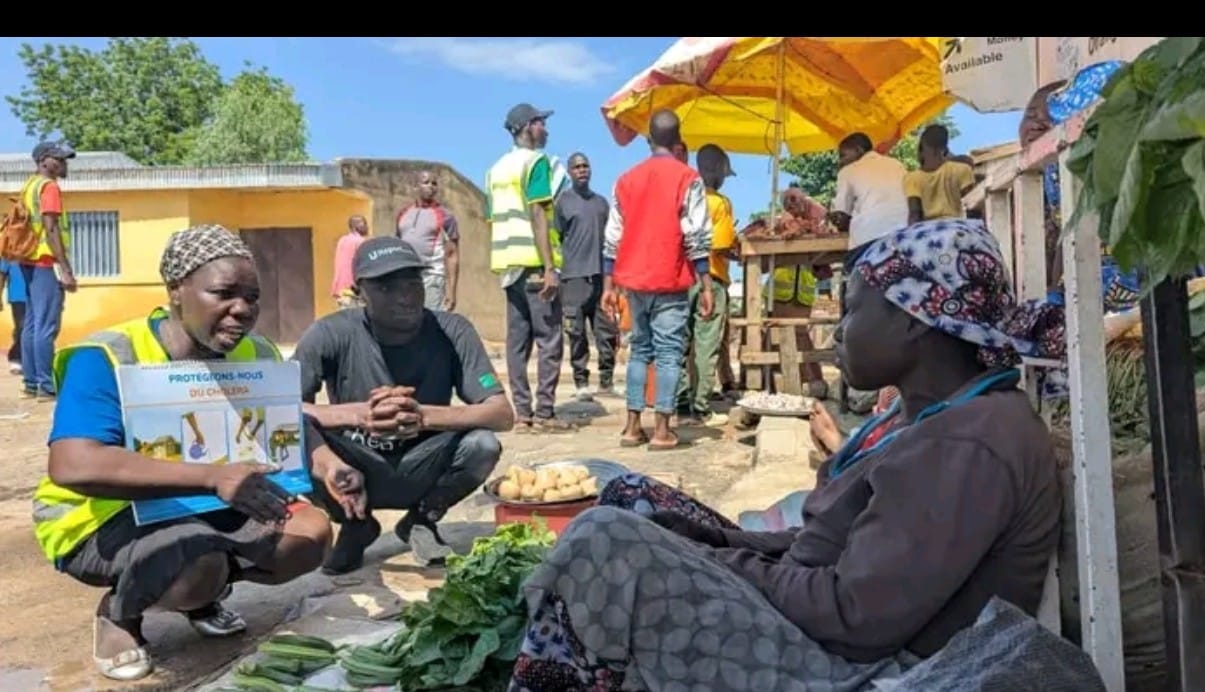
Faced with the rapid spread of cholera cases within communities, U-Responders have stepped up their interpersonal awareness campaigns. This mobilization is crucial to a multi-sectoral response supported by UNICEF.
The cholera response is intensifying in the Far North of Cameroon.As of July 22, 2026, the Far North region had recorded 585 cases of cholera and 19 deaths across eight health districts. This heavy toll represents a case fatality rate of 3.25%.
Children and vulnerable populations are bearing the brunt of this threat caused by the Vibrio cholerae bacterium. In a region already weakened by limited access to clean water and significant population movements with neighboring Nigeria and Chad, stopping the chain of transmission is of vital importance.
To this end, U-Responders volunteers are actively mobilizing for field operations.Raising awareness at the local level in householdsOn the prevention front, young people in the U-Report network prioritize interpersonal communication and community engagement. Volunteer teams have already reached 15,068 people in households and public spaces in Kousseri, Kolofata, Maroua, Maga, Mora, and Moutourwa.
In Garoua, Guider, and Pitoa, educational talks on hygiene and preventative measures have gathered 717 people. In parallel, the national ≠StopCholera campaign has been running on social media from July 18 to July 25, 2026, to amplify prevention efforts among young people.An urgent multi-sectoral responseThis youth mobilization is part of a broader response strategy deployed by UNICEF in support of the Regional Public Health Delegation.
Concrete actions are structured around several key areas: distribution of treatment kits for approximately 300 patients and deployment of 25 kits for acute watery diarrhea in the most affected areas (Mada, Makary, Fotokol, Kousseri, Maroua III); targeted disinfection of homes and public spaces, reaching more than 2,500 households (approximately 15,400 people) to contain the spread; and specialized care in Sagme for 51 cholera survivors, including 30 children, to ensure their full recovery.
Through this door-to-door communication, the young people of the community prove that this approach remains the most effective weapon to quickly adopt good hygiene practices and direct suspected cases to health centers.An urgent need for fundingDespite progress on the ground, the scale of the needs still exceeds the available resources.
To maintain and intensify vital operations until the end of 2026, UNICEF estimates the emergency budget at US$930,000 (approximately 560 million FCFA), allocated primarily to access to water and sanitation, healthcare, and community outreach.