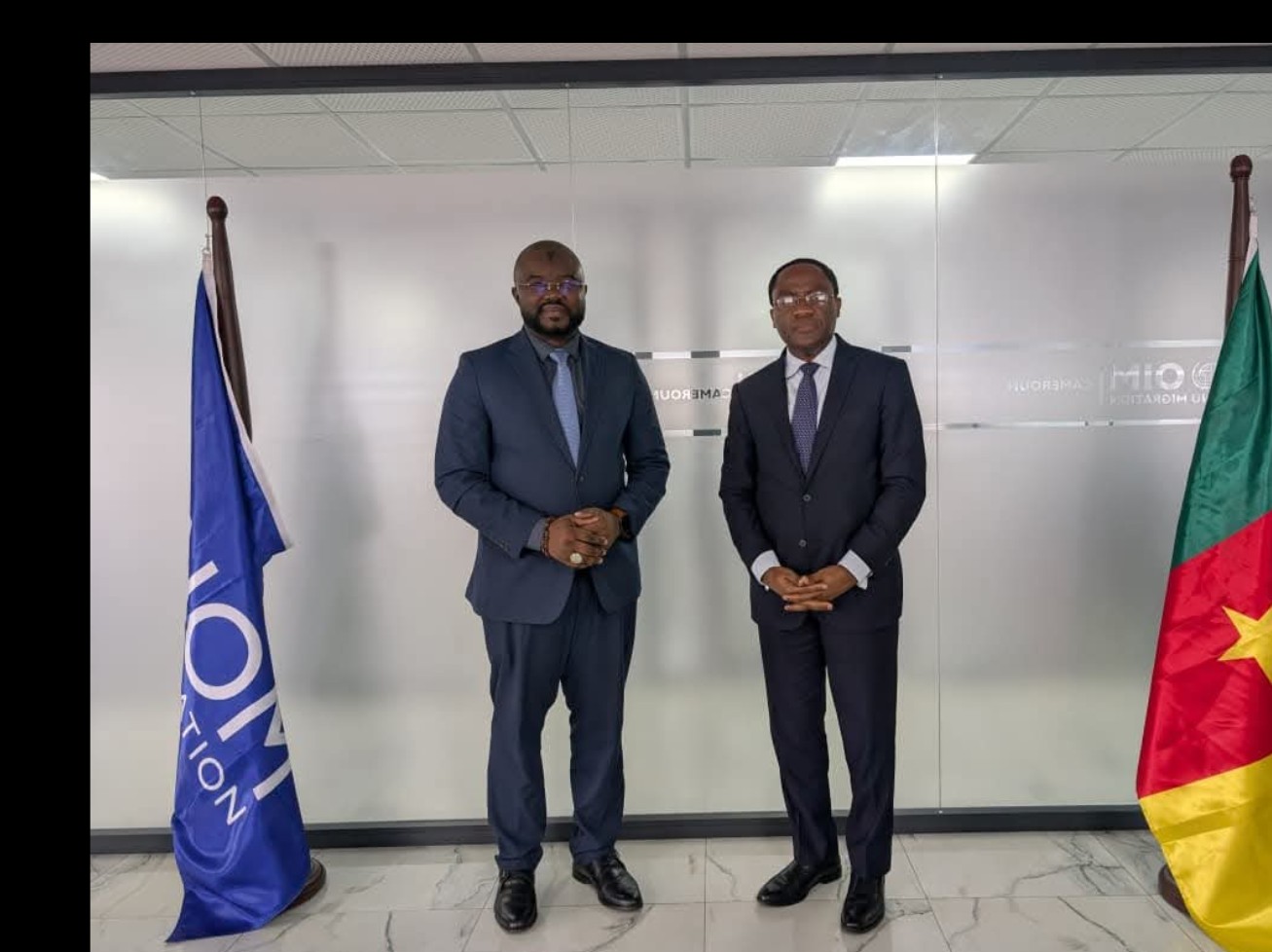
The International Organization for Migration (IOM) Cameroon and the Denis & Lenora Foretia Foundation want to strengthen their collaboration around migration, diaspora engagement and climate-related mobility.
Migration is increasingly emerging as a cross-cutting issue, at the intersection of development, climate, peace, and security. It is in this context that the IOM Chief of Mission in Cameroon met with Dr. Denis Foretia, co-chair of the Denis & Lenora Foretia Foundation, to discuss opportunities for strengthening their collaboration.
Discussions focused in particular on research, innovation, and the use of data to improve public policy development. This is a particularly important issue in a context where population displacements are linked to several factors, including conflict, economic hardship, and the effects of climate change.
In Cameroon, IOM already has significant tools for collecting and analyzing displacement data. Its Displacement Tracking Matrix (DTM) allows for the documentation of population movements, their characteristics, and their needs. During an assessment conducted in May-June 2025, more than 700,000 internally displaced persons, returnees, or refugees outside camps were identified in the areas covered.
The climate dimension is also a strategic focus. IOM data shows that environmental changes can influence mobility decisions. In a 2023 survey of migrants in Cameroon, Mali, and Niger, 39% of those who had witnessed environmental
changes or disasters stated that these events had contributed to their decision to migrate.
For both organizations, the challenge is therefore to better translate this data into public policy. This includes anticipating displacement, strengthening community resilience, and better integrating climate mobility into development and adaptation strategies.
The diaspora is another identified lever. The Foretia Foundation has already dedicated work to the transfer of skills from the Cameroonian diaspora, particularly through mechanisms for temporary migration and sharing of expertise likely to support innovation and entrepreneurship in Cameroon.
This convergence between migration expertise, research, and public policy opens up broader prospects for cooperation. It could help to make migration not only a matter of management and protection, but also a lever for development, innovation, and resilience for Cameroon.
The challenge now will be to translate these exchanges into concrete initiatives, capable of bringing data, research and public decision-making closer together.