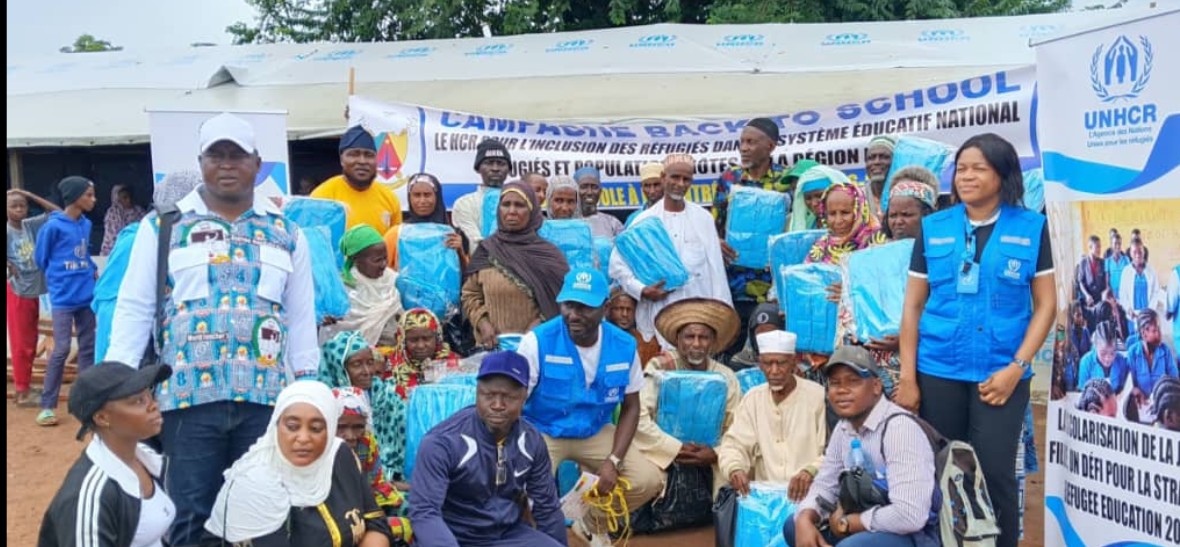
Of the 51,737 refugee adolescents of secondary school age in eastern Cameroon, only 917 are actually attending school, representing a gross enrollment rate of 1.8%. Faced with this low coverage, the United Nations High Commissioner for Refugees (UNHCR) is intensifying its « Back to School 2026-2027 » campaign, launched on September 1st in Gado-Badzéré, in the Garoua-Boulaï district.
The situation is concerning. According to data from the 2024/2025 school census, the eastern region has 17,926 refugee children of preschool age, 53,088 of primary school age, and 51,737 adolescents of secondary school age. However, only 568 children are enrolled in preschool, representing 3.2% of the total, compared to 26,897 in primary school, for a gross enrollment rate of 50.7%. At the secondary level, the number drops to 917 students.
This break between primary and secondary education exposes many refugee adolescents to the risk of school exclusion. The distance to schools, lack of supplies, limited capacity, the cost of schooling, and the precarious socioeconomic conditions of families are among the main difficulties cited.
In addition to these constraints, there is the food situation. Several participants reported a food shortage that is weakening families and directly affecting learning. « A child who goes to school on an empty stomach has great difficulty concentrating and learning properly, » emphasizes Maleboua Daniel, president of the Committee of Parents of Refugee Students in Garoua-Boulaï. He calls for increased humanitarian assistance.
The teacher shortage is another concern. In some schools, class sizes are high while the available staff remains insufficient. Parents are calling for better monitoring and increased support for teachers. « We implore you to continue this support, particularly by strengthening the monitoring and support of teachers, in order to guarantee a quality education for our children, » pleads a refugee parent.
Faced with these challenges, the « Back to School 2026-2027 » campaign aims to encourage the enrollment, re-enrollment, retention, and transition to school for refugee children. It also seeks to strengthen the involvement of parents, communities, schools, and education authorities. UNHCR reiterates that every child, girl or boy, including those living with disabilities, must have access to
inclusive and quality education.
Particular attention will be paid to students in exam classes, especially the final year of primary school (CM2) and the final year of middle school (3e), to strengthen their support and facilitate their exam preparation. This initiative comes in a context marked by the withdrawal of some partners and the continued need for educational support.
The issue of birth certificates is also central to the action. A registration process for refugee children attending school is scheduled to begin in October. « Following your numerous complaints regarding birth certificates, we have decided to register refugee children to allow them to obtain this essential document, » an official stated during the meeting.
The campaign is based on a community-based approach involving parents, teachers, educational authorities, and community leaders. To facilitate understanding and participation, the messages are translated into Sango or Fulfulde.
Representing the Regional Delegate of the Ministry of Basic Education (MINEDUB), Mr. Mendong Justin called for greater discipline, punctuality, and diligence. He emphasized the synergy between teachers, parents, schools, and communities, in line with the theme of the 2026-2027 school year: « Reading, writing, arithmetic: a shared commitment, a promise for every student. »
Beyond access to education, UNHCR frames this campaign within a broader child protection approach. In Garoua-Boulaï, a social center allows for the reporting of situations that could jeopardize children’s education or well-being. The goal is to guarantee refugee children sustainable access to quality education and to preserve their chances of building a future.
Lutricia Atol