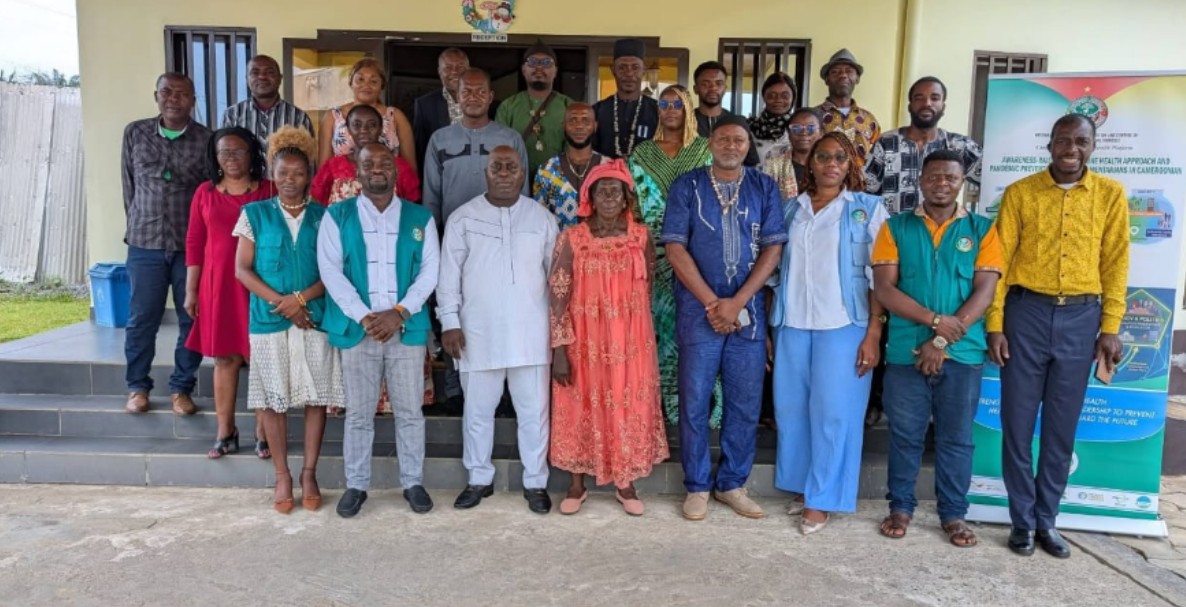
In response to the cases of Mpox recorded since the beginning of 2026, the city of Kribi mobilized its community leaders from September 1st to 3rd. A strategic workshop organized by the Zoonoses Program equipped these leaders to promote the « One Health » approach within the population.
The seaside town of Kribi, prized by tourists for its fine sandy beaches, is also a region under strain due to health concerns. With cases of Mpox recorded since the beginning of the year, risks of contamination of bathing waters by pathogens, and the threat of vector-borne disease outbreaks, this jewel of Cameroon’s southern coast faces a complex health reality. In response to this situation, the Zoonoses Programme, part of the One Health platform, brought together community leaders from the town from September 1st to 3rd, 2026, for a crucial engagement workshop, transforming these local actors into true guardians of public health. For it is at the grassroots level, within their communities, that the prevention of health crises is determined.
The importance of community involvement in the prevention and control of zoonotic diseases is undeniable. For three days, these leaders received training on a wide range of crucial topics. They began by exploring the mechanisms of zoonoses, diseases transmitted from animals to humans, and the integrated « One Health » approach, which links human, animal, and environmental health. But their training didn’t stop there. They were also made aware of Antimicrobial Resistance, a silent threat that renders treatments ineffective, as well as Food Safety. A key component of the workshop focused on community diagnosis, Risk Communication and Community Engagement (RCCE), and developing effective messaging. Finally, in a world where information travels at lightning speed, they learned to combat the
infodemic and to leverage social media to disseminate reliable prevention messages.
At the end of the workshop, the community leaders, now equipped with the necessary tools, solemnly pledged to promote the « One Health » approach within their communities. This commitment is all the more crucial given that the city of Kribi has faced an Mpox outbreak. While some twenty positive cases were officially reported, medical teams responded swiftly, providing free and effective care that prevented any deaths. Health authorities, such as Dr. Domo Joséline, head of the Mpox treatment unit in the district, are reassuring the public, stating that the situation is under control and that the start of the school year can proceed safely. This responsiveness is a strong signal, but prevention remains key.
By training its community leaders, Kribi is not simply reacting to crises; it is building a bulwark. The « One Health » approach is becoming a territorial strategy here, a concrete response to an environment where health risks are multiple. These men and women, now fully aware of the issues, are essential links in an inclusive and sustainable health chain, capable of meeting the challenges of tomorrow, from the beach to the forest, from animals to humans.