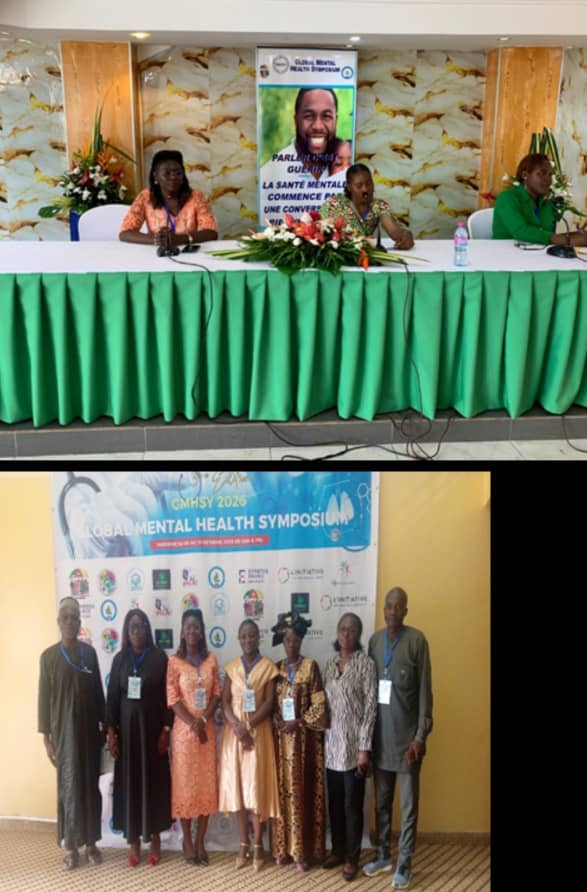
Bringing together researchers, clinicians, civil society, and institutions on October 9 and 10, 2026, this conference dissected deep trauma, gender-based violence, and professional burnout.
Under the auspices of World Mental Health Day, the Cameroonian capital resonated with humanity and resilience on October 9 and 10, 2026. Hosting the third edition of the Global Mental Health Symposium, the event established itself as an essential platform to encourage open dialogue around the theme: « Lived Experiences Heard: True Voices, Real Change. » Bringing together researchers, clinicians, civil society organizations, and institutional actors, the proceedings examined the multiple facets of psychological suffering while casting a courageous eye on the sociocultural and structural determinants shaping population well-being.
The relevance of the topics addressed was reflected in field realities, starting with the burning challenge of positive masculinity and gender-based violence. Opening the dialogue on pathways of violence and femicide, panelists highlighted men’s psychological vulnerability in the face of traditional societal expectations. Illuminating this social and health emergency, Dr. Marilene Kemme Kemme, Deputy Director of Mental Health at the Ministry of Public Health, underlined the full significance of the symposium, explaining that « this symposium puts the individual back at the center of concerns and brings mental health within everyone’s reach, because everyone has lived or is living through a mental health experience. » She also stressed the absolute necessity of multisectoral synergy, specifying that « these cross-cutting interventions, particularly with MINPROFF and MINAS, allow us to provide strong institutional solutions to support populations. »
The scientific sessions also shone a harsh light on deep psychological trauma and tragic acts, illustrated by poignant qualitative studies on domestic violence and familial determinism. Researchers demonstrated how unaddressed early-childhood trauma, combined with psychological vulnerabilities, paves the way for irreversible tragedies. In the same vein, mental health at work was thoroughly analyzed through professional burnout among healthcare providers and chronic stress in hospital environments. Reflections then extended to prison populations and people living with HIV, proving that social inclusion and psychosocial support constitute the indispensable pillars of sustainable community resilience.
Innovation also held a prominent place during these two days, notably through the exploration of digital technology and artificial intelligence to expand access to psychological care. From self-screening to online consultations via dedicated applications, participants discovered
solutions tailored to local realities. In closing these proceedings rich in recommendations, Dr. Marilene Kemme Kemme issued a vibrant call to action: « We must go beyond the symposium and actively work to make mental health interventions a daily reality. » It is an ambitious roadmap aimed at ensuring mental health is no longer a taboo, but a shared priority for all Cameroonians.

« We Must Go Beyond the Symposium and Make Mental Health a Daily Reality »
On the occasion of the third edition of the Global Mental Health Symposium held in Yaoundé as part of World Mental Health Day, Dr. Marilene Kemme Kemme, Deputy Director of Mental Health at the Ministry of Public Health, reflects on the crucial issues of these proceedings. From positive masculinity and digital innovation to institutional responses, she decodes the priorities of an essential multisectoral approach.
Doctor Marilene Kemme Kemme, good day. You coordinate and drive the vision for mental health within the Ministry of Public Health. What does this third edition of the Global Mental Health Symposium represent for Cameroon?
This symposium takes place as part of the celebration of World Mental Health Day and is part of a broad array of activities deployed across the national territory, ranging from awareness campaigns and free consultations to marches and community outreach rounds. This year, we are exploring the theme: « Lived Experience, True Voice, Real Change. » It is a powerful theme that puts the individual back at the center of our concerns and places mental health within everyone’s reach, because each of us has lived or is living through an experience related to mental health. We wanted to bring together researchers, healthcare professionals, civil society actors, and individuals with lived experiences to share these stories. This rich diversity of interventions will enable us to formulate strong recommendations.
The two-day program addresses extremely sensitive topics deeply rooted in current Cameroonian events, such as positive masculinity, femicide, and gender-based violence. How does the Ministry structure its response to these challenges?
We are indeed addressing several major themes. One of them is dedicated to positive masculinity, directly linked to current issues in our country, particularly gender-based violence, femicide, and infanticide. To tackle this, we conduct cross-cutting interventions in close collaboration with the Ministry of Women’s Empowerment and the Family (MINPROFF) and the Ministry of Social Affairs (MINAS). The objective is to clearly identify existing institutional solutions in Cameroon to support populations affected by these tragedies. The vision of the Sub-Directorate of Mental Health is clear: we want to move from health determinants toward a comprehensive institutional response, covering primary prevention, secondary intervention, and tertiary care.
Mental health is no longer limited to medical offices or traditional psychiatric facilities. What role do you give today to innovation and community involvement?
A central role! We have a session dedicated to community mental health to measure the impact and strength that the community can mobilize in our interventions. At the same time, technological innovation is entering our practices. During these sessions, innovative solutions designed for self-screening, emotional well-being assessment, and online consultations via dedicated applications are presented to the public. These are modern tools that facilitate access to care and allow everyone to pay attention to their psychological health on a daily basis.
Beyond the rich exchanges of these two days, what is the political and practical objective of this symposium?
This event is above all a major advocacy platform. It is about bringing ideas together to formulate concrete recommendations that will be submitted to the various hierarchical authorities. We must build concerted, multisectoral interventions because it is only by working together across all sectors of the State and society that we will truly be able to improve the mental health of our fellow citizens. My closing words are to express sincere thanks to all partners, organizations, and participants who made this symposium possible. Above all, I launch an appeal to action: we must imperative go beyond the symposium and act daily to make mental health a tangible reality in the lives of Cameroonians.