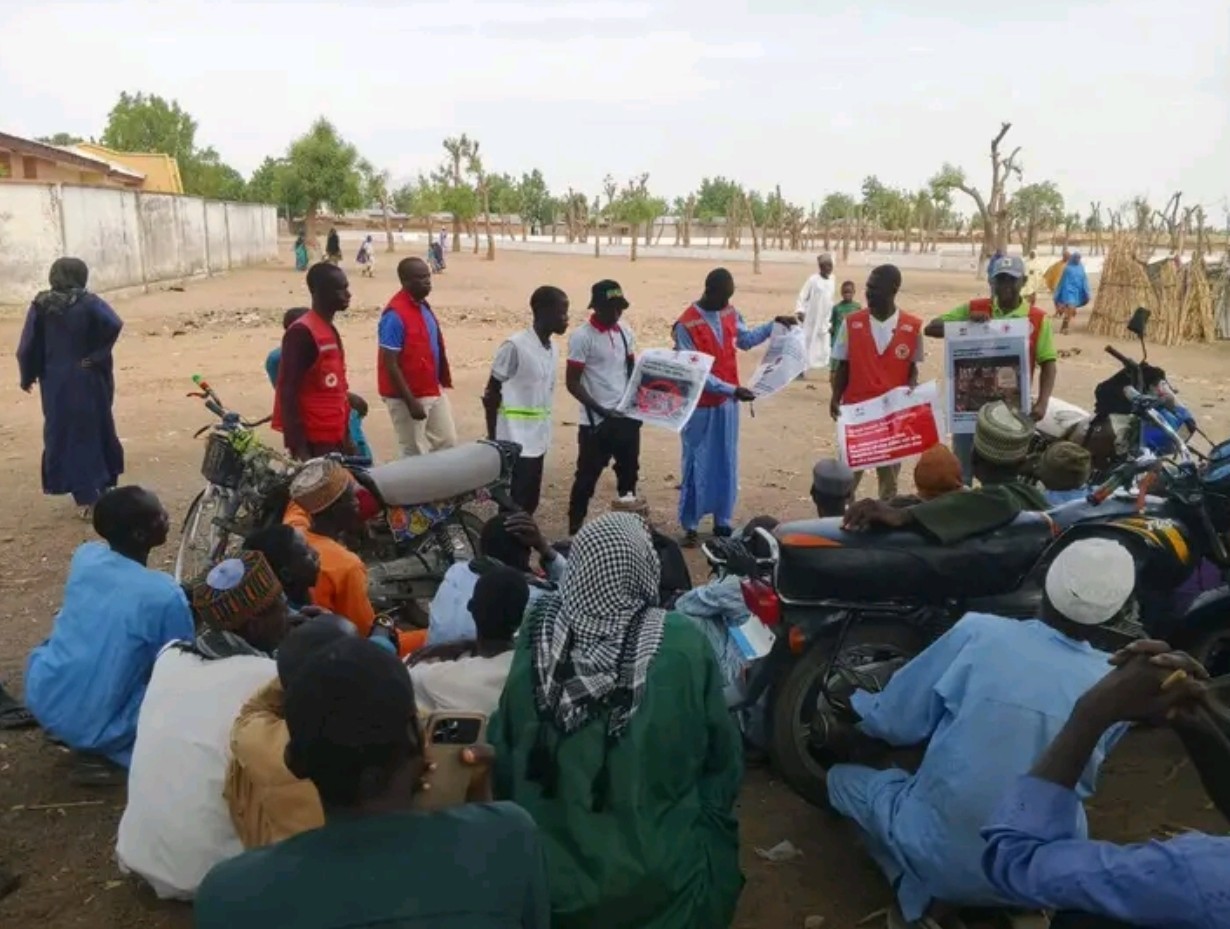
Volunteers from the Cameroonian Red Cross Departmental Committee in Kolofata are raising awareness among internally displaced populations about the dangers of fire and good cooking practices, in order to prevent fires in the camps.
In Kolofata, a town in the Far North region, teams from the Cameroonian Red Cross departmental committee are stepping up their awareness campaigns among internally displaced populations. Living conditions in the camps there make households highly vulnerable to fire, in a context already marked by significant socio-economic vulnerability.The Far North of Cameroon is one of the poorest regions in the country. This situation is explained by a combination of structural and cyclical factors. On the one hand, climatic hazards are frequent and severe: prolonged droughts reduce agricultural yields and exacerbate food insecurity, while intense rainfall, concentrated over short periods, regularly causes floods that destroy homes, crops, and infrastructure. In Kolofata, these phenomena further weaken already vulnerable populations.In addition to these natural constraints, there is the security situation. Incursions by armed groups in the Lake Chad Basin have led to massive population displacements. Kolofata thus hosts many internally displaced persons living in camps or spontaneous settlements. These spaces are often overcrowded, with shelters built from straw, wood, and tarpaulins—highly flammable materials.Under these conditions, the fire used daily for cooking becomes a constant threat. In Kolofata, a simple, poorly controlled fire can quickly escalate into a blaze, ravaging several homes in minutes. The losses are then heavy: destroyed property, consumed food, and sometimes human lives lost.Faced with this reality, the volunteers of the Cameroonian Red Cross in Kolofata are adopting a community-based approach. They organize awareness sessions in small groups, adapted to the local context and the realities of households. Practical demonstrations play a central role: how to safely light a fire, where to set up a cooking fire, and how to quickly extinguish a small fire.The messages broadcast in Kolofata emphasize concrete actions: maintaining a distance between kitchens and homes, clearing the surroundings of flammable materials, never letting children handle fire unsupervised, and providing rudimentary extinguishing devices such as sand or water nearby.In total, 3,312 people were reached in Kolofata as part of this campaign, conducted with the support of the International Red Cross and Red Crescent Movement. Beyond the numbers, the goal is to create lasting behavioral change in an environment where every mistake can have serious consequences.In a region like the Far North, where crises overlap—structural poverty, climate hazards, insecurity, and population displacement—prevention emerges as an essential strategy. In Kolofata, the Cameroonian Red Cross goes beyond emergency response: it works to strengthen community resilience by empowering them to better protect themselves against everyday risks.Thus, in Kolofata, each awareness session becomes a further step towards reducing domestic disasters, in a region where the slightest improvement in living conditions can have a significant impact on the survival and dignity of the population.Samuel ADJEWA