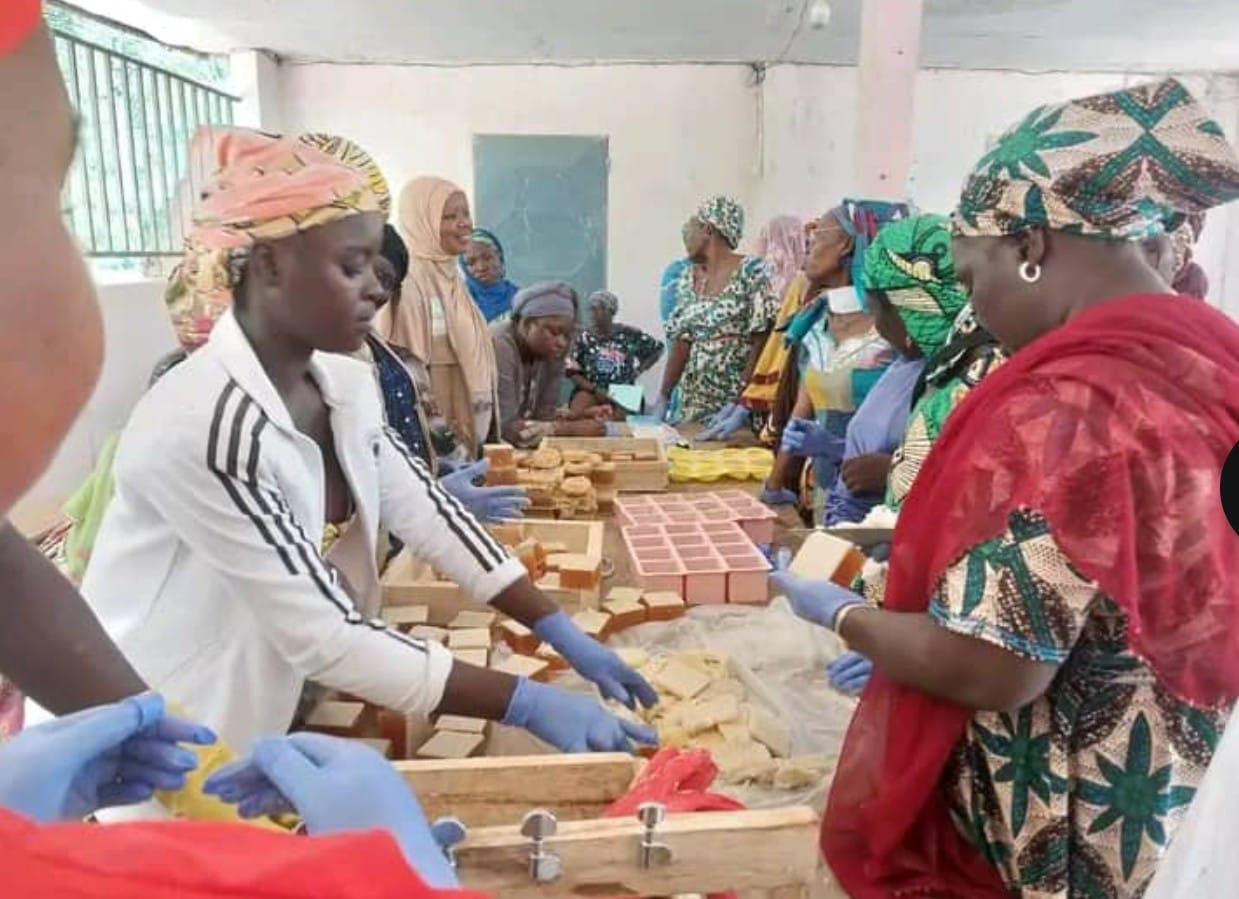
On July 31 and August 1, 2026, in Mokolo, more than fifty women affected by the security crisis in the Mayo-Tsanaga department were trained in the techniques of making solid and liquid soap. This initiative aims to strengthen their economic independence while improving hygiene conditions in their communities.
Women affected by the security crisis in the Mayo-Tsanaga department now have a new tool to rebuild their autonomy. For two days, July 31 and August 1, 2026, more than fifty beneficiaries participated in a practical training course on solid and liquid soap making techniques at the Women and Family Promotion Center (CPFF) in Mokolo.
The workshop was organized by a consortium comprised of EFA Cameroon, Dorcas Hand Work, and HAIF (Holistic Access Initiative Foundation). Guided by soap-making experts, participants learned about all stages of production, from selecting raw materials to packaging the finished products. The training alternated between theoretical sessions and practical exercises to enable participants to acquire immediately applicable skills.
The participants came primarily from the villages of Woudahaï and Ouro Tada, where the Hilton Foundation-supported Improving Food Security through Resilience Project is being implemented. They were joined by displaced women who had fled violence in the localities of Mayo-Moskota and Tourou. Organized into two associations, these women received training designed to promote their economic integration and develop income-generating activities.
Beyond the economic aspect, this training also addresses a public health issue. By mastering soap making, participants will be able to produce an essential product for daily hygiene. This increased availability of soap will help prevent waterborne diseases and other infections linked to poor hygiene, which are still common in several rural communities in the region.
The closing ceremony took place in the presence of administrative and traditional authorities. Customary leaders, the departmental delegate for Social Affairs, and the director of the Mokolo Women and Family Promotion Center received samples of the soaps made during the training. These demonstrations highlighted the quality of the products created by the participants after just two days of intensive training.
A highlight of the ceremony was the presentation of certificates to all participants, marking the completion of their training. The event’s sponsor, Ms. Ramatou Songola Atikou, praised the initiative, which restores confidence to women affected by the security crisis. She stated that economic empowerment is a crucial tool for enabling participants to regain their dignity and fully contribute to the development of their communities.
For the departmental delegate of Social Affairs, this training represents a concrete
response to the difficulties faced by displaced and vulnerable women. She encouraged the beneficiaries to put their newly acquired knowledge into practice in order to create small income-generating activities for the benefit of their families.
For her part, the director of the Mokolo Women and Family Promotion Center was delighted to have hosted this capacity-building session. She encouraged the participants to share this expertise with other women in order to amplify its impact in the various communities of Mayo-Tsanaga.
This activity is part of the Improving Food Security through Resilience Project, implemented by the EFA Cameroon, Dorcas Hand Work, and HAIF consortium with support from the Hilton Foundation. Beyond food security, the project develops several initiatives aimed at strengthening the resilience of populations affected by the security crisis in Mayo-Tsanaga, with a particular focus on women’s empowerment.
The organizers now hope to see small community soap-making units established in the beneficiary villages. In addition to creating sustainable sources of income for these women, this initiative will help improve household hygiene and reduce the risk of waterborne diseases. This approach makes training a true lever for resilience, dignity, and hope for communities severely impacted by years of insecurity.