Capable of breathing air, resisting piranha bites and catching birds in mid-flight, this giant fish fascinates as much as it impresses.
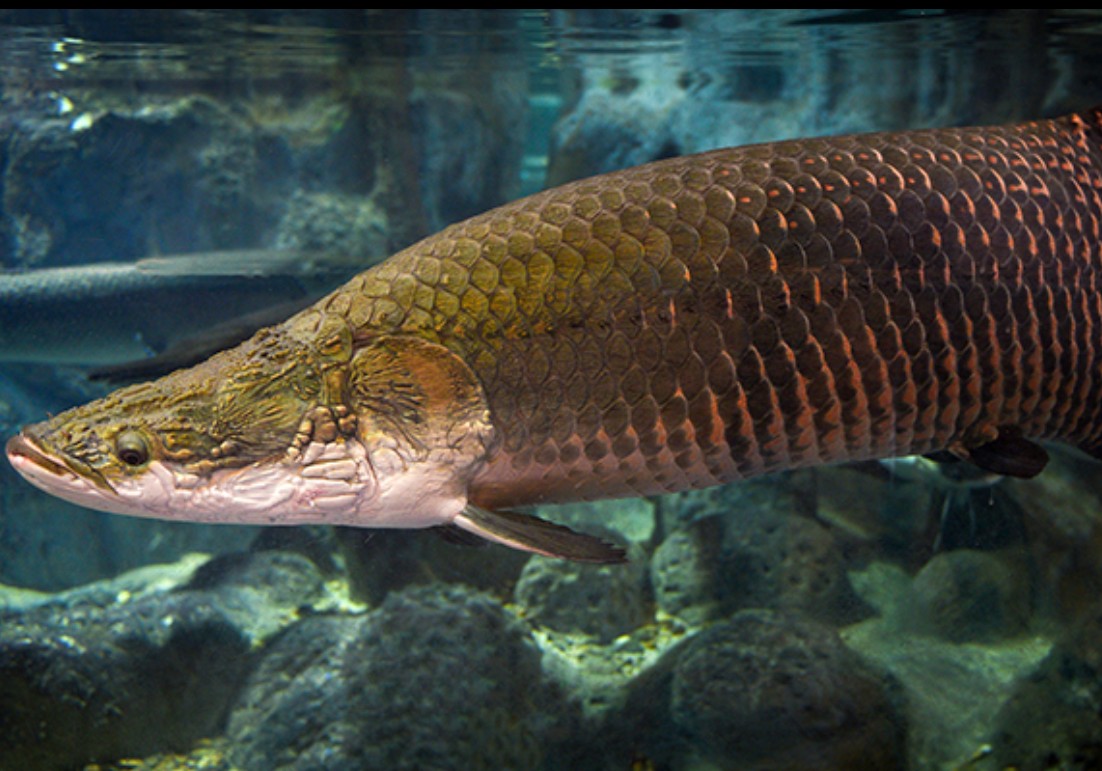
Nicknamed pirarucu by Native American peoples— »pira » for fish and « uruku » for red—in reference to the scarlet pigmentation that adorns its tail, this freshwater giant can reach nearly 3 meters in length and weigh over 200 kilograms. It is the largest bony fish in South America and one of the most imposing on the planet. But what makes the arapaima truly exceptional is not just its extraordinary size. It is its incredible ability to survive in hostile environments where other species perish. In the Amazon basin, where the stagnant, warm waters are often oxygen-poor, this giant has developed a unique evolutionary adaptation: obligate air breathing. Its swim bladder, modified into a veritable lung, allows it to inhale surface air every 15 to 20 minutes. Without this regular ascent, it would literally suffocate. This behavior, fascinating to observe, makes it vulnerable during the dry season, but ensures its undeniable dominance over habitats inaccessible to its competitors.
Its streamlined body, with its green-grey sheen, a true masterpiece of evolution, conceals another secret: a natural anti-piranha armor. Its scales, both rigid and flexible, are composed of two distinct layers. An extremely hard, mineralized outer layer, combined with a fibrous and absorbent inner layer, forms a biological « bulletproof vest. » The piranhas’ sharp bites slide off or shatter against this structure, effectively protecting the giant from the scavengers’ attacks.
Its bony tongue—characteristic of the Osteoglossidae family—is covered in small, tough teeth, which local populations traditionally use as a rasp after drying. This is further proof that every part of this fish has found its purpose, both in the ecosystem and in human practices.
Finally, the arapaima is a formidable hunter. An opportunistic carnivore, it suddenly sucks in its prey by creating a powerful vacuum in its wide mouth. But its most spectacular technique remains its leaps out of the water: with a powerful flick of its tail, it can launch itself to capture birds or small mammals perched on low branches. A display of strength that leaves those lucky enough to witness it speechless.