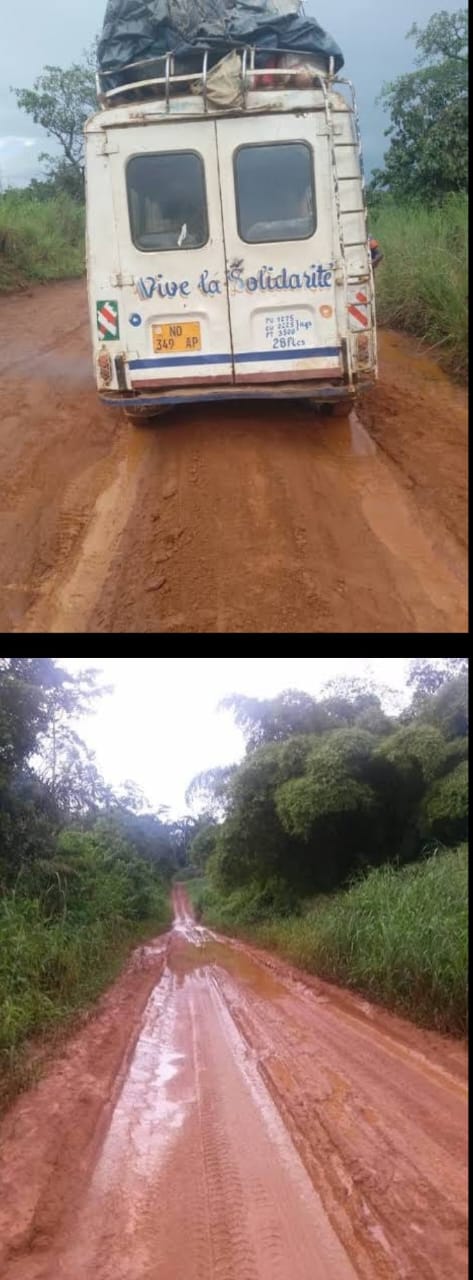
The poor condition of the region’s road network makes medical evacuations difficult. Getting to Ngaoundéré from Bankim, Banyo, Mayo-Baléo, Tignère, or Djohong is a real ordeal that can cost the patient’s life.
When patients need to be evacuated to hospitals with advanced technical facilities, every minute counts. The stories from users are strikingly similar. To evacuate a patient in distress, ambulances, often old and worn-out, have to navigate broken roads, deep ruts, weakened bridges, and flooded water crossings. Trips that should take an hour stretch into several hours, with violent jolts that worsen the patients’ condition. Medical staff, as is the case in Banyo, Mandourou, or other remote areas of the region, try to provide local follow-up to avoid evacuations. In the dry season, the challenge is dealing with dust, but in the rainy season, the situation is entirely different. The risk of complications and death rises, and families watch their hopes and health unravel on the road.
The consequences are human, economic, and social. Besides the loss of avoidable lives, the costs families face to rent adapted vehicles or pay for transfers are huge. Prevention campaigns are less effective when accessibility remains lacking.
It’s urgent to take action. Beyond statements, public authorities need to speed up the rehabilitation of key routes, ensure transparency in public contracts, and equip local health facilities to reduce patient transfers. In the short term, providing all-terrain ambulances and stabilization kits could prevent tragedies. Technical and financial partners, as well as civil society, also need to step up so that Adamaoua stops being a region where the road can decide life or death. Citizens deserve healthcare access that doesn’t depend on the condition of a track that should instead help ease people’s suffering.
Endless roadworks
At a time when every minute counts in a medical emergency, the road network in the Adamawa region tragically reminds us that access to healthcare isn’t just a question of having medical facilities available it’s first and foremost a question of roads. During the work of the 19th session of the regional council dedicated to the adoption of the 2025 financial statements, Aliou Issa, the president, pointed out in his report to lament the poor condition of Adamawa’s roads. What was supposed to contribute to the region’s development has instead become the source of its problems. This is the case, for example, with the Ngaoundéré-Pont Paro stretch that connects Ngaoundéré to Tignère, which is 70 km long and whose work began on September 5, 2019. To date, barely 35% has been completed despite more than 100% of the deadline being consumed. Part of the President’s Three-Year Emergency Plan, this project is dragging on.
For the people, the wait is unbearable. The local health centers, already fragile, are facing a double blow. They see serious cases being sent off to Ngaoundéré without
any guarantee they’ll arrive, while also dealing with a drop in activity due to transportation difficulties. The public works minister’s visit to the region stirs up the population’s worries about promises that were never kept. Starting construction work in this part of the country right now worries people, especially knowing that this period is marked by heavy rainfall.