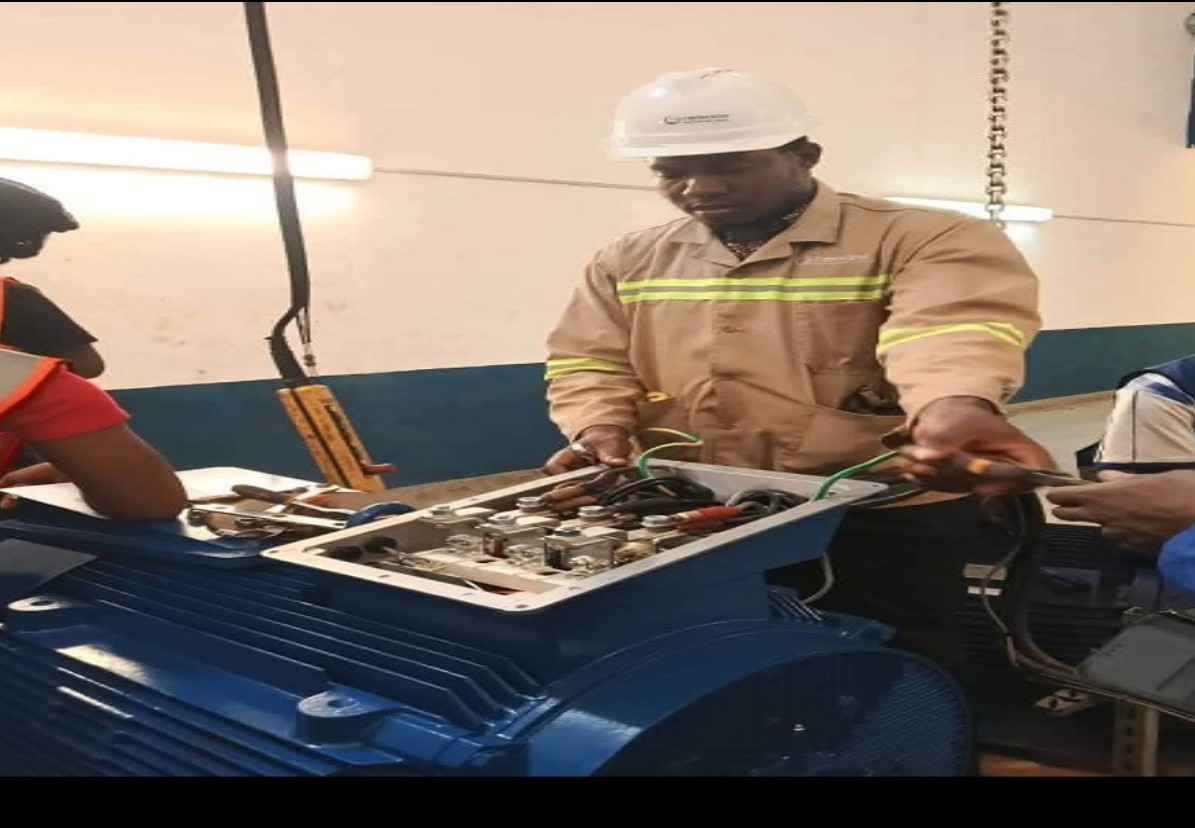
During the night of August 21-22, 2026, the installation of a new Lowara electric pump in Mbankolo made it possible to reach an overall flow rate of 330 m³/h, ending rationing for thousands of households.
On the night of August 21-22, 2026, as Cameroon’s political capital descended into silence and darkness, a silent revolution unfolded within the Mbankolo pumping station. While thousands of households slept, a newly installed Lowara electric pump began its initial technical tests around 1:00 a.m. However, it wasn’t the hum of the motors that marked that night, but two essential pieces of data, two numbers that have become symbols of rebirth: 220 and 330. Seemingly cold, these numbers actually chart a new course for the distribution of drinking water in Yaoundé.
The first of these figures is the nominal flow rate of the new installation. This isn’t just a technical specification; it’s a quantified promise. With a capacity of 220 cubic meters per hour, the Lowara electric pump was rigorously selected based on its characteristic curves, a guarantee of measured and controlled performance. It was operational by dawn on August 22nd. But the real achievement lies in the synergy of complementarity. Combined with the existing equipment, the station now boasts a total flow rate of 330 cubic meters per hour. This combined figure isn’t simply an addition; it represents a significant increase in capacity.
This performance boost is a game-changer against daily inconveniences. Specifically, more than 330,000 liters of treated water can now be distributed every hour. This increase in capacity has a direct and immediate impact: rationing on the Mbankolo Haut water supply is officially abolished. With the pressure restored, it is no longer a meager flow climbing the slopes, but a controlled, regular, and sufficiently powerful current to reach the highest reservoirs. The end of water cuts, hesitant trickles, and the daily struggle to find water is now a tangible reality for these households.
330 m³/h: a breath of fresh air all the way to Mont Fébé
However, the positive ripple effect doesn’t stop at Mbankolo. The second effect of this hydraulic revolution is broader, driven by the same pressure dynamic. The increased capacity benefits an entire distribution ecosystem: the Mount Fébé area. Thanks to this new hydraulic boost, the pressure in the pipes has significantly stabilized. Households and businesses connected to the recent network extensions are now reaping the full benefits.
A smoother, more reliable flow of water is now the norm in these long-neglected areas. Where water once arrived with difficulty, sometimes only trickling in, it now flows steadily. This figure of 330 m³/h acts as a catalyst, resolving distribution problems across two major plateaus of the city. It’s not just about liters of water; it’s about simplified lives, hotels and residences regaining comfort and services, and businesses finding their operations secure.
A quantified policy for a sustainable ambition
These results are not a matter of chance, but rather the outcome of an emergency plan implemented by CAMWATER’s General Management. Behind the new electric pump lies a comprehensive strategy for modernizing pumping
infrastructure. Increasing the volume of water distributed is not merely a matter of convenience; it is a crucial response to Yaoundé’s exponential population growth. By increasing the capacity of the Mbankolo site, the public utility is closely aligning itself with actual demand.