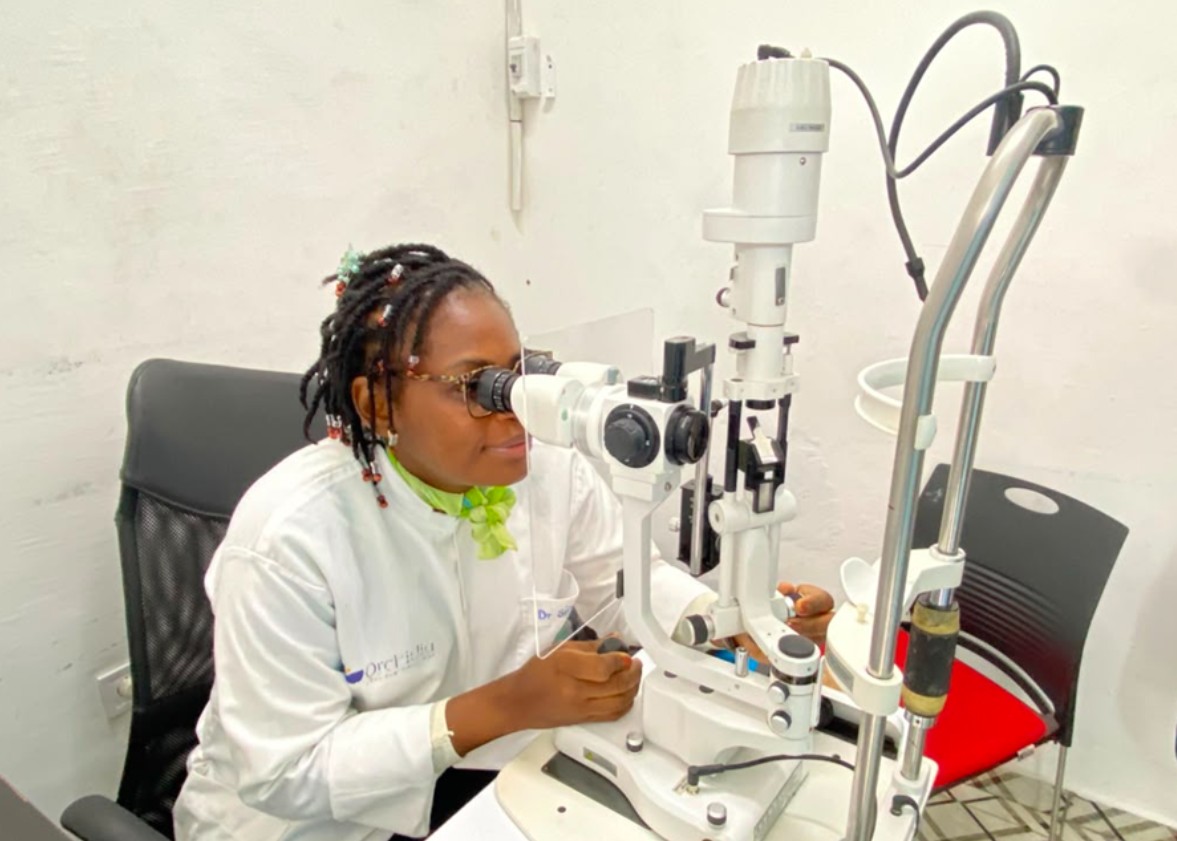
In partnership with the Lions Club of Douala, this health facility organized on October 8, 2026, an awareness campaign featuring free consultations and eye examinations at 50% reduced costs.
Thursday, October 8, 2026, was a day dedicated to sight around the world under the theme: « Love Your Eyes ». At the Deido District Hospital, the choice was made to mark this Thursday in both timing and spirit. The ophthalmology department of the said health facility took a full day to consult people of all ages free of charge. Parents and children seized the opportunity to undergo specific examinations at heavily discounted rates. A 50% reduction that brought joy to many. « I came to get examined because of an ailment I’ve been suffering from for nearly a year. My vision is blurry, and sunlight has become a major issue for me. I am also unable to read written text, whether the characters are small or large. Until now, I couldn’t undergo thorough examinations due to a lack of money. But here I went through all the machines with very little money. Really, with less than twenty thousand francs, I underwent specific examinations. Now I know what is wrong with me, » says Amélie N.
Adèle came with her two children suffering from conjunctivitis: « I paid nothing. We were consulted for free, prescribed medication, and asked to return, » she reports. The attending physicians are categorical. Dr. Françoise Ngosso and Dr. Simo affirm: « Protecting your eyes means protecting your future. » Indeed, they repeated this message to patients to reflect their commitment to caring for everyone.
Turning to global vision health, the World Health Organization and the International Agency for the Prevention of Blindness indicate that 2.2 billion people live with a vision impairment or blindness—even though much of the damage could have been prevented. While statistics in Cameroon provide limited details on the issue, those for Sub-Saharan Africa are revealing. According to the WHO, approximately 140 million people live with a vision impairment. « It is the region with the highest rate of blindness per capita, » we are informed. In the classification of
ailments, « cataracts account for nearly half of blindness cases due to a very low ophthalmologist-to-population ratio, sometimes fewer than one ophthalmologist per 500,000 inhabitants in certain countries, » it is revealed.
Furthermore, although sharply declining thanks to prevention campaigns, diseases like trachoma or onchocerciasis, also known as river blindness, persist in certain rural pockets.
Cataracts Remain the Leading Cause of Blindness
For health professionals, uncorrected refractive errors—including myopia, hyperopia, astigmatism, and presbyopia—are the primary cause of vision impairment worldwide. Conversely, cataracts remain the leading cause of blindness in low- and middle-income countries. According to the WHO, they account for approximately 50 to 51% of global blindness cases, representing nearly 20 million completely blind individuals. Glaucoma accounts for about 8 to 11% of blindness cases worldwide and is the leading cause of irreversible blindness globally. It is estimated to affect over 80 million people, many of whom are unaware due to its asymptomatic onset, according to the International Agency for the Prevention of Blindness (IAPB). There is also age-related macular degeneration, which remains a frequent cause of vision loss among people over 50, particularly in developed countries. Lastly, diabetic retinopathy affects approximately 1 million people who have gone blind and tens of millions living with retinal lesions. Its prevalence is rising at the same pace as the global diabetes epidemic, reports the IAPB.
Alphonse JENE