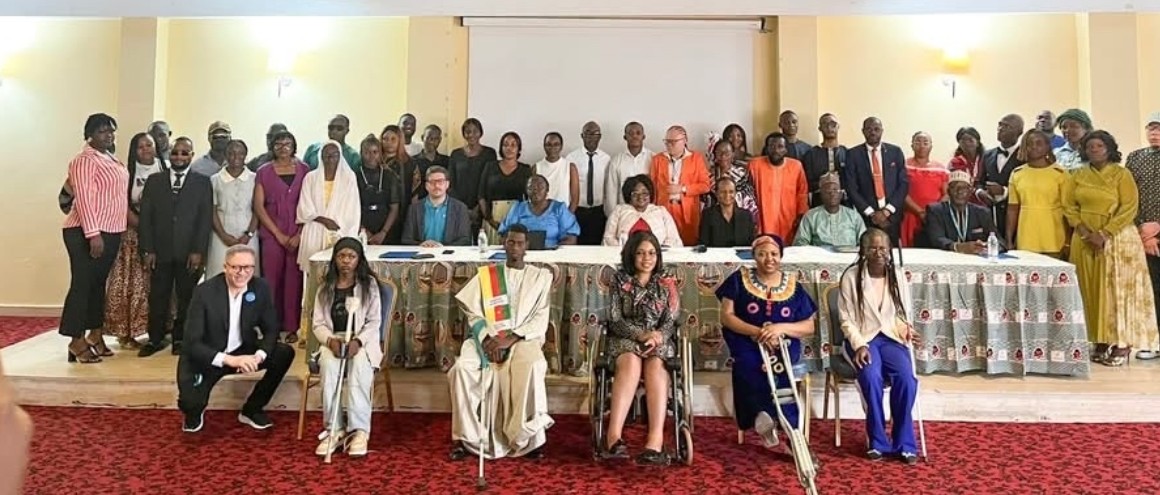
The three day training workshop, launched on October 26 in Yaounde by the Ministry of Social Affairs and UNICEF, brings together participants from organisations of persons with disabilities across all ten regions to strengthen inclusive practices in essential services.
Cameroon is strengthening its approach to disability inclusion through a national training of trainers workshop designed to improve how frontline workers respond to the needs and rights of persons with disabilities. Opened on October 26, 2026, in Yaounde, the three day initiative is jointly organised by the Ministry of Social Affairs (MINAS) and UNICEF.
The workshop brings together 24 participants and trainers drawn from organisations of persons with disabilities across the country’s ten regions. Its objective is to build a pool of qualified trainers capable of transferring their knowledge to frontline workers, who play a key role in connecting people with essential services, including healthcare, education, housing and employment.
Nothing about us without us
A defining feature of the initiative is its commitment to the principle “Nothing about us without us”. By placing organisations of persons with disabilities at the centre of the training process, the workshop recognises their role in promoting their rights and shaping more inclusive services.
Over three days, participants are expected to strengthen their understanding of disability diversity, inclusive teaching methods and a human rights based approach grounded in the Convention on the Rights of Persons with Disabilities.
Speaking at the opening, UNICEF Representative in Cameroon Nadine Perrault stressed the need to dismantle the social barriers that prevent persons with disabilities from fully accessing essential services. She also drew attention to the heightened risks of exclusion and violence faced by children with disabilities.
For her, recognising rights is not enough. Those rights must be reflected in everyday interactions, whether at a social service office or in a healthcare facility. Strengthening the skills of frontline workers is therefore an important step towards ensuring that every child receives respectful and inclusive treatment.
Extending skills beyond the workshop
The initiative is based on a cascade training approach. Following a regional training session held in N’Djamena, Chad, under the “Building Resilience in the Sahel” programme, the Yaoundé workshop seeks to establish a national network of trainers able to extend inclusive practices to regional and local levels.
The approach is intended to broaden the reach of disability inclusion training beyond the initial group of participants. By equipping trainers to share their knowledge with other professionals, the programme aims to encourage more consistent practices across services and communities.
However, the long term impact will depend on how effectively the training is rolled out across the ten regions, as well as on the commitment of institutions to apply the principles learned. The number of frontline workers to be trained and the timetable for subsequent sessions have not been specified in the available information.
Linking inclusion to social protection
The workshop also takes place within a national legal and policy framework that includes Cameroon’s 2010 law on the protection and promotion of persons with disabilities, alongside the country’s international commitments on disability rights.
Beyond awareness raising, the initiative is expected to contribute to better identification and referral of persons with disabilities, as well as their integration into the Unified Social Registry. These efforts are relevant to improving access to social protection, although their implementation will require appropriate institutional coordination.
Opening the workshop on behalf of the Minister of Social Affairs, the ministry’s representative reaffirmed the importance of protecting vulnerable populations and promoting their inclusion.
Ultimately, the success of the initiative will be measured not only by the knowledge acquired during the three days of training, but also by the changes it brings to frontline services. Extending these skills across the country and translating them into more accessible, respectful and non-discriminatory practices will be essential to making disability inclusion a reality.